Resources for Teaching Interdisciplinary Writing in Middle School
Interdisciplinary prompts can help strengthen students’ writing skills while deepening their understanding of different subjects.
Your content has been saved!
Go to My Saved Content.
Middle school teachers arrive for their first professional learning session on a new interdisciplinary writing course. Coffee, devices, writing tools in hand, materials and snacks spread across the table. Everyone settles into their seats.
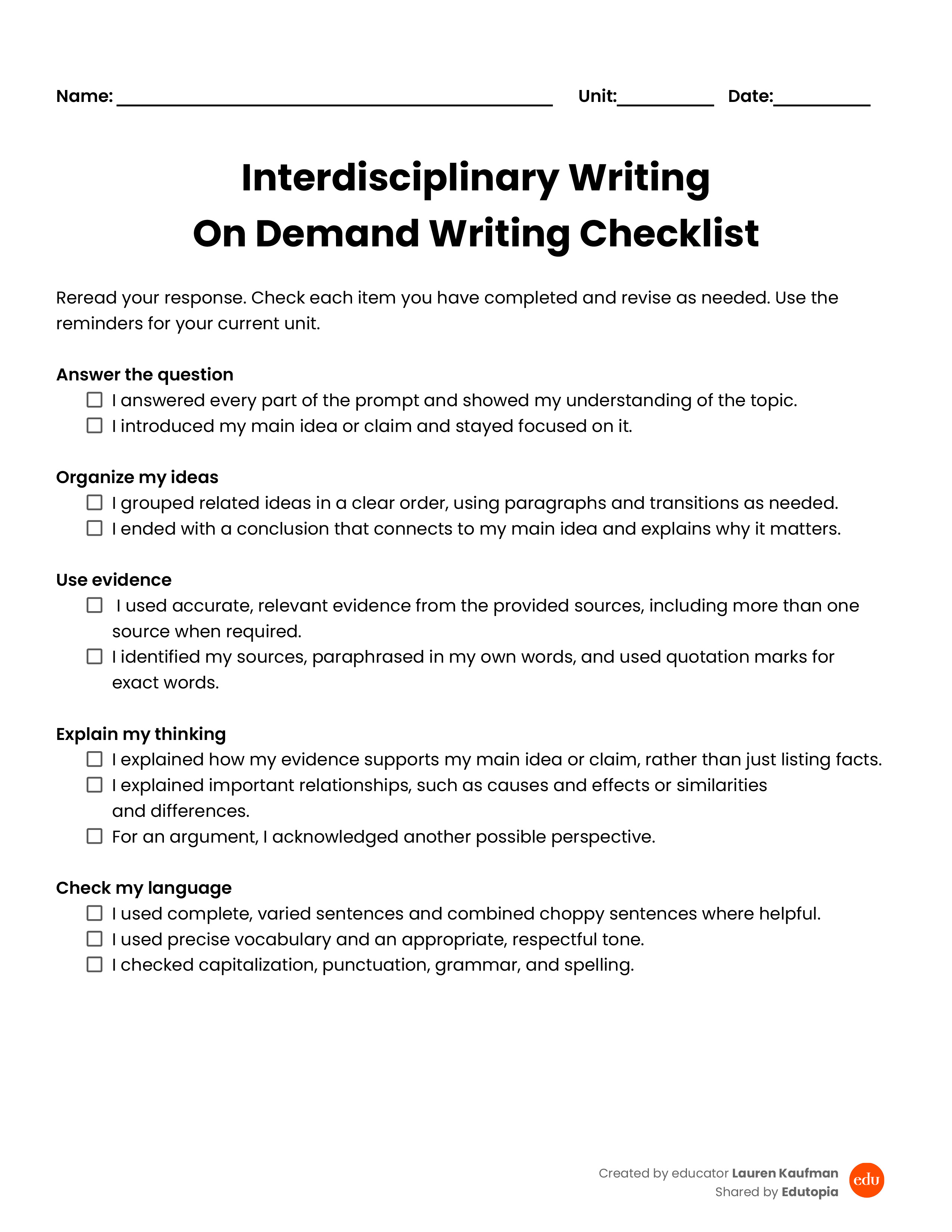
As the instructor, I explain that the course was created to help teachers strengthen students’ foundational writing skills while deepening their understanding of science and social studies. I hand teachers a short text about ecology, a diagram, and an interdisciplinary writing student checklist.
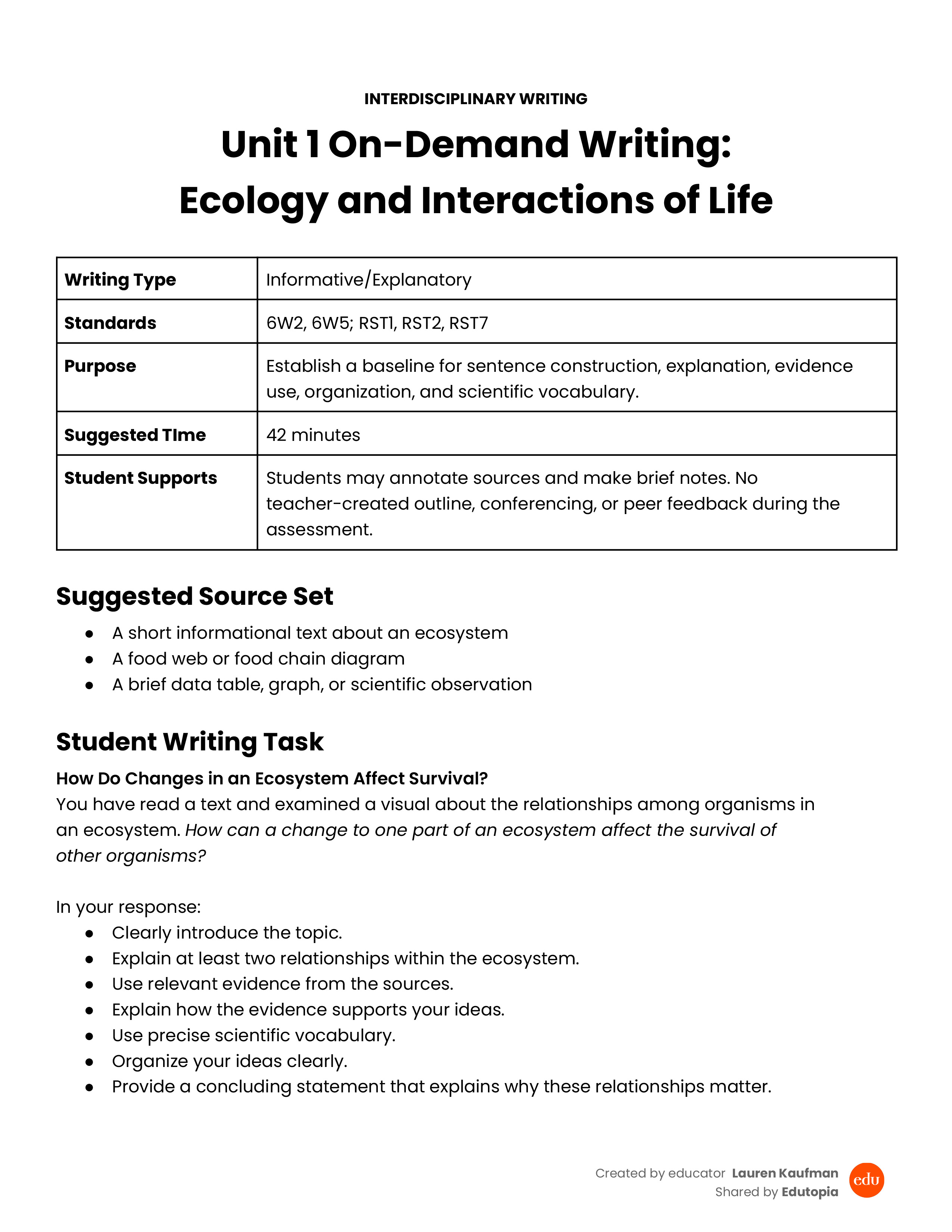
Then, I post this prompt:
You have read a text and examined a visual about the relationships among organisms in an ecosystem. How can a change to one part of an ecosystem affect the survival of other organisms?
In your response:
- Clearly introduce the topic.
- Explain at least two relationships within the ecosystem.
- Use relevant evidence from the sources.
- Explain how the evidence supports your ideas.
- Use precise scientific vocabulary.
- Organize your ideas clearly.
- Provide a concluding statement that explains why these relationships matter.
I see a few mouths drop open and notice some teachers fidgeting in their seats. I stop and ask, “What are you thinking right now?”
“It’s been a long time since I’ve written like this,” one teacher says. Another: “I wasn’t expecting to write right away.” A third isn’t sure they know enough about the topic to write about it well.
I set the timer for 10 minutes. When time is up, I ask them to share their writing with a colleague using the checklist to identify strengths and opportunities to grow. I explain that students begin and end each unit with a 42-minute, on-demand writing task. The first provides a baseline and the second helps us see their progress. When students write to teach someone what they’ve learned, they can show their understanding and make their own learning stick.
I want teachers to experience the same uneasiness that students might feel when writing about content they are still learning—so the teachers can better understand how to support them.
Planning Around the Content
When I began designing this course, I worked with my curriculum leadership team to connect it to what students are learning in science and social studies: ecology and interactions of life, Eastern Hemisphere civilizations, human impact, and comparative world religions.
Using a curriculum articulation document, I mapped out each unit’s topics, standards, writing skills, learning experiences, resources, and assessments.
As we planned the units, I kept coming back to this question: What would students need to know and have in front of them before they could write about this topic?
We linked text sets of articles, media, phenomena, diagrams, and simulations in the curriculum document. As students move through the ecology unit, they read and discuss multiple texts and visuals about how a change in an ecosystem can affect other organisms. These sources and conversations build their knowledge and give them ideas to generate their writing. By the time students are ready to write a more complete explanation, they have something to say.
Teaching Writing Moves
That first writing experience made something clear to us: Students need to learn both the content and how to explain it in writing. We used the Writing Revolution approach and pacing guide to make those moves concrete enough to model and flexible enough to use across science and social studies.
In Unit 1, students work on foundational writing skills, such as writing complete sentences, identifying fragments, sentence expansion, applying subordinating conjunctions and transitions, using appositives, and combining sentences.
I created slide decks to give teachers a clear way to model each writing move with their own writing. For example, in the sentence-expansion lesson, teachers show students how a sentence can grow from a simple idea into a more complete explanation: “Predators compete.” > “Predators compete for food.” > “Predators compete for food within the same ecosystem.” > “Predators compete for food within the same ecosystem because resources are limited.”
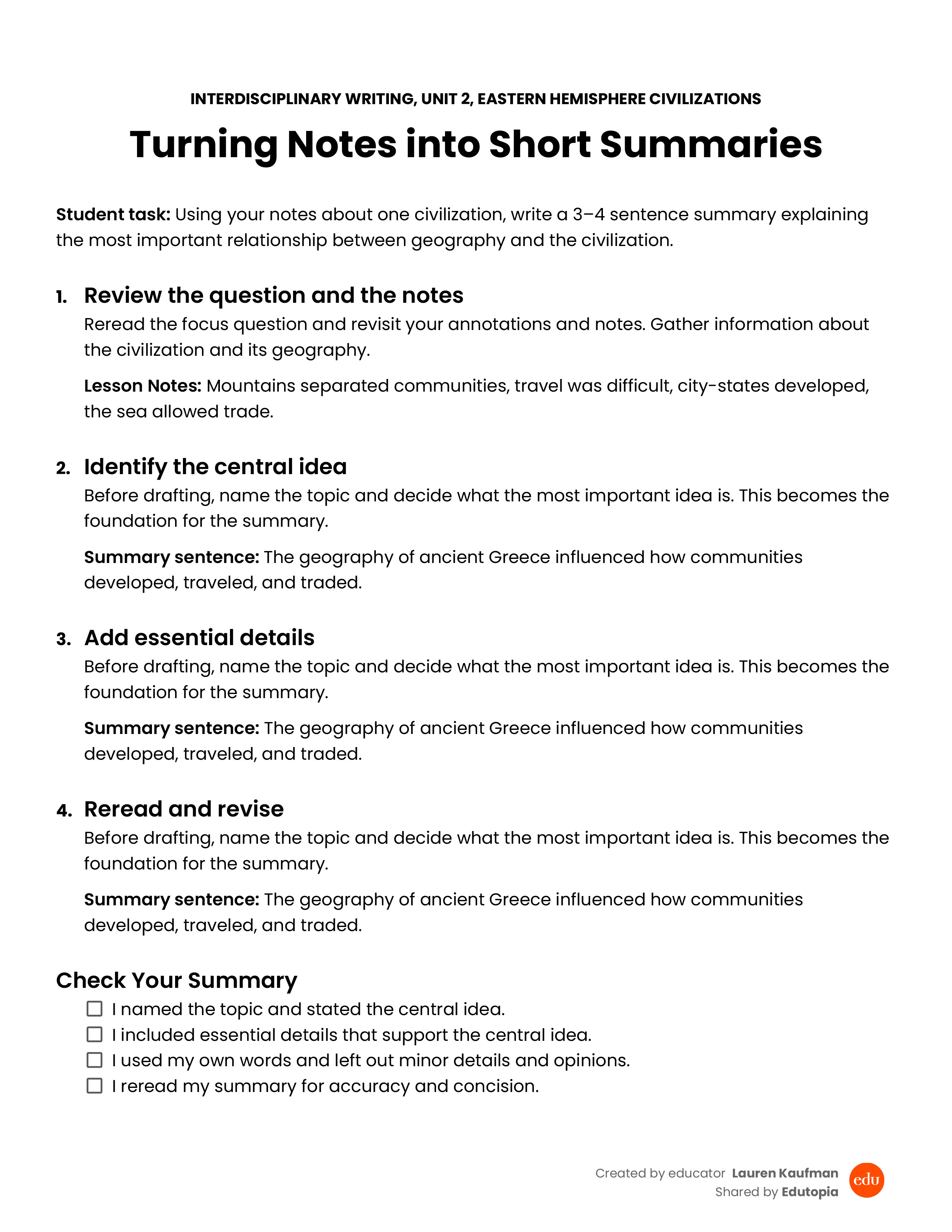
In a summary writing lesson from our Eastern Hemisphere civilizations unit, students review their notes and decide what matters most. They write one sentence that captures the main idea and add details to build a three- or four-sentence summary. In our ancient Greece lesson, they use this process to explain how geography shaped where people settled, how they traveled, and what they traded. A checklist helps them make sure they have included the most important information.
Students then apply these foundational skills to more complex tasks, including developing claims and organizing details into single and multi-paragraph outlines.
Tracking student writing and growth
Writing growth can be difficult to see from one assignment to the next. To allow students and teachers to look back and see progress over time, you can have students keep their writing in notebooks (while also making digital writing tools available to students who need them).
When I dropped into a common planning meeting, I asked a teacher how the course was going. She told me, “The on-demand writing was very telling. I know exactly what I have to teach and have the resources to help students get there. And, I even told the kids that I did this writing!”
After a student read a text and studied a food web diagram, their notebook response continued to grow: “Snakes eat mice.” > “Snakes eat mice in this ecosystem.” > “Snakes eat mice in this ecosystem because mice provide the energy snakes need to survive.” With each expansion, the student moved from naming a relationship to explaining why it matters for survival.
These moments took me back to the room where teachers faced a writing task and hesitated to begin. I realized they had carried that experience into their classrooms. When students have familiar content to write about and the tools to put their ideas into words, they can build the confidence to express what they know.