A Poetry-Writing Exercise to Support English Learners
In this lesson, high school students write ‘I am’ poems in their home language and then translate them into English, building crucial literacy skills.
Your content has been saved!
Go to My Saved Content.
When I first taught newcomer English language development, student learning was often hindered by the adopted curriculum. It was too basic and relied on simple identification and memorization tasks. Once, students voiced doubts over the relevance of learning how to address a mailing envelope. From the teacher’s side, I also noticed how decontextualized the curriculum was from their daily lives. This ultimately bored them and diminished their enthusiasm for learning.
All my students held knowledge in another language, yet the curriculum seemed to ignore this, so I decided to modify my curriculum to home in on the multilingual and multicultural nature of my classroom and incorporate it into their learning.
As I redesigned the curriculum, I decided to use culturally relevant texts so that students could use their lives and experiences to construct meaning from the content. Moreover, to leverage students’ home languages, I centered my practice around translation as a tool to access and make meaning from the content. Garcia and Kleifgen posit that incorporating students’ home languages and dialects in the classroom rejects monolingual ideologies and allows for linguistic freedom and fluidity.
I’ll explain how I incorporated translation into a new curricular unit to cultivate meaning-making and authorship within my students.
Poem Translation and Meaning-Making
The curricular unit I designed aligned with culturally responsive pedagogy and centered around David Bowles’s narrative poetry book They Call Me Güero. Since poetry is shorter, I believed it would be easier to unpack using translation as compared with longer prose texts. Furthermore, the poems in this book contained experiences, cultural beliefs, customs, and traditions that resonated with my students.
I selected three poems for this unit, “Spanish Birds,” “Border Kid,” and “The Newcomer,” and focused on one of these poems per week. I created close reading small groups, based on student needs, where we read the poem and used translation to unpack it.
First, we translated the poem from English to Spanish or the students’ respective home languages, for surface-level understanding. Once the translation of the poem was complete, I guided students through a deeper analysis of the poem, focusing on literary elements (word choice and main idea) and figurative language (imagery, similes, metaphors). I facilitated this analysis by
- selecting a phrase from the poem that utilized figurative language/literary elements,
- referencing our translation of that phrase, and
- discussing the purpose of its use and the meaning it added to the poem.
In this process of using translation and our home languages in group discussions of the poems, my students experienced deeper levels of understanding, thinking, and meaning-making for each poem.
After doing this for the three-unit poems, students moved on to using translation as a means for becoming multilingual authors.
Creation of Bilingual ‘I Am/Yo soy’ Poems
For the last week of the unit, students wrote bilingual “I Am/Yo soy” poems, to showcase their lives, cultures, and experiences—demonstrating pride in their identities and backgrounds.
First, students wrote their poems in their home language. They were allowed to write creatively and freely, but a framework was provided for students who needed guidance.
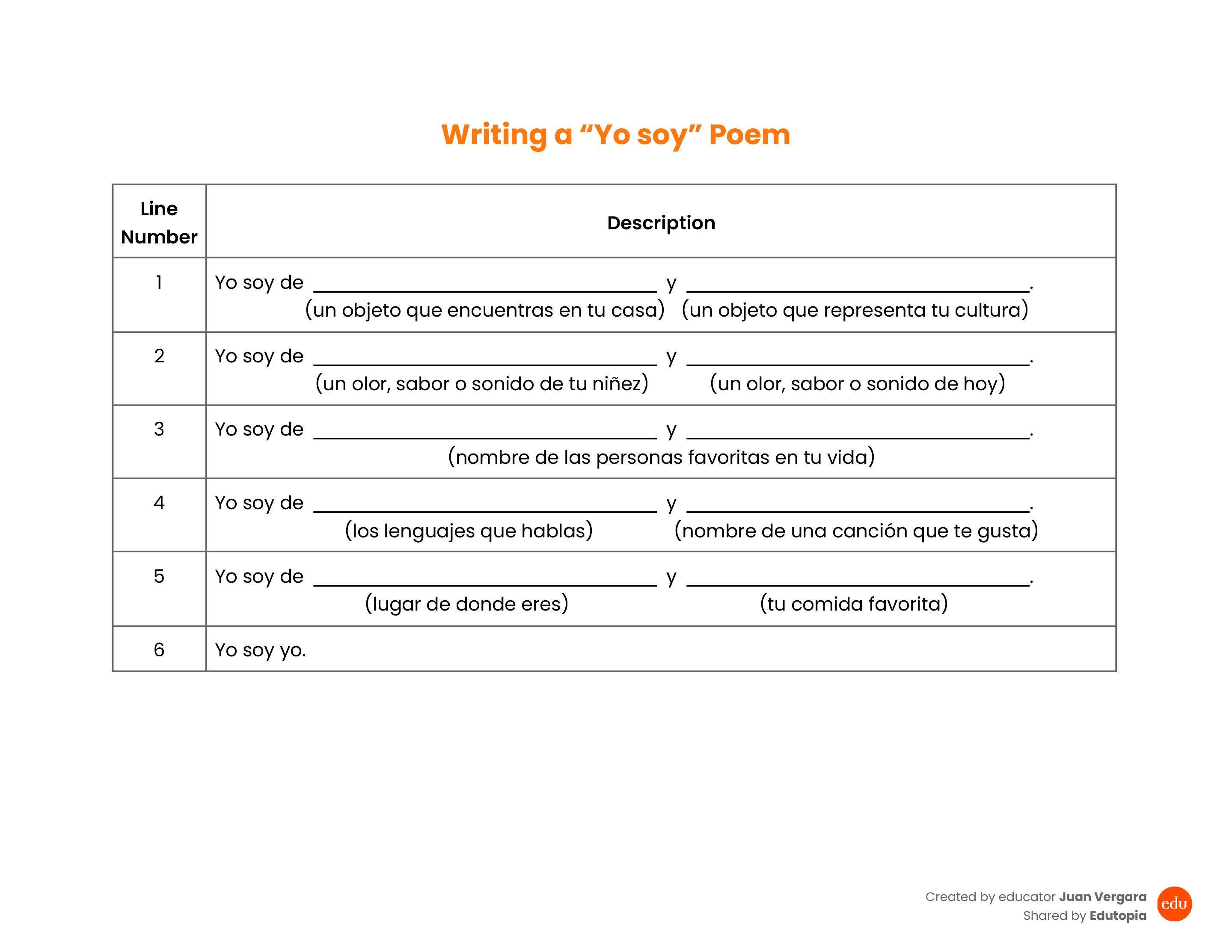
After writing their poems in their home language, students translated their own poems or a peer’s into English. The goal was to use what they had learned about translation to retain the poem’s original meaning in the English translation. This meant that students needed to focus on selecting the most appropriate word in English and changing the structure of a phrase to match English conventions (e.g., putting an adjective before a noun). This immersed students in the real-world skills and details of translation work.
Once the poems were translated into English, I compiled all of my students’ poems in a journal (showcasing their bilingual poetry side-by-side), which was then shared with our school and local community—digitally and then physically through copies printed by a local company. In doing this, students’ home languages were respected and valued, and their emerging multilingualism was uplifted.
My students became bilingual authors. Translation facilitated writing between their home language and English. Rather than simply writing to fill in blanks (as was the case with the adopted curriculum) or writing simple sentences, students curated their own texts and had the space to write openly and creatively.
Positive Student Outcomes and Levels of Engagement
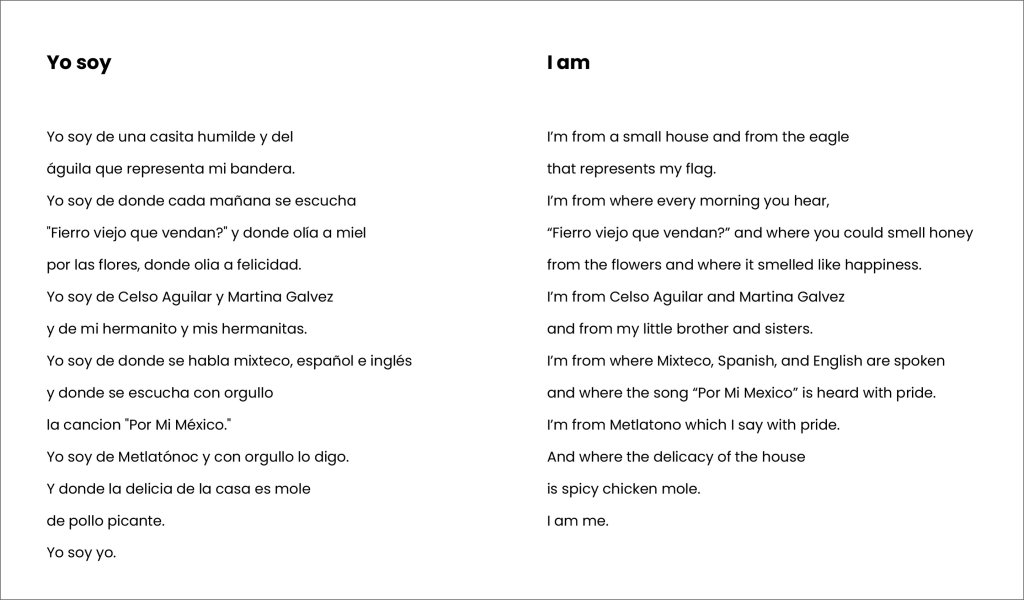
After the incorporation of the unit, I noticed a boost in confidence and engagement from my students. Their participation in close reading discussions increased and boosted creativity in their writing. In one student’s poem (shown below), they referenced their country and hometown, and the joyful memories they bring, demonstrating pride and confidence in their Mexican identity.
Additionally, the process of translation allowed students to engage with language at three linguistic levels specific to their own learning trajectory and needs.
Lexical level engagement: Some students used translation as a vehicle to build their English vocabulary, making word-level connections between English and their home language. For example, these connections can look like students understanding what a word in English is in their home language so that when they encounter the word in the future, they recall what it is. With translation work, students are able to identify the translations of specific words, even if they do not have an entire sentence or phrase translated.
Semantic level engagement: Some students used translation to expand their thoughts about the poetry from They Call Me Güero. They unpacked figurative language to understand its intended meaning. For each poem, I selected a phrase with figurative language. As a class, we used our translation of the phrase to discuss possible meanings and the speaker’s purpose for using it in the poem. I repeated this process for other phrases in the poem.
Pragmatic level engagement: A handful of my students focused on engaging with English to think about meaning, tone, and audience by paying specific attention to a word’s connotation, meaning, and tone when translating a text. For example, with Border Kid, students discussed whether to use desnivelado or chueco for the Spanish translation of “uneven.” One student mentioned that chueco felt weaker and informal; therefore, not a strong translation. Another student argued that chueco was more appropriate because it is a common word, accessible to a larger audience than desnivelado.
Translation supported my students’ linguistic needs in English and their home language. As a result, they experienced noticeable academic and linguistic growth.
Leveraging students’ home languages in the classroom with tools like translation can help make students’ stories visible. In doing so, learning a new language becomes fun for students. Their unique voices are amplified through an outlet where they can share their cultures and stories, and engage with a meaningful curriculum.