5 Ways to Increase the Quantity and Quality of Students’ Writing
Having students move beyond descriptive paragraphs and five-paragraph essays can help improve their ability to write—and their love of doing it.
Your content has been saved!
Go to My Saved Content.
In upper elementary and middle school writing assignments, there’s often an emphasis on expository and analytical writing, such as descriptive paragraphs or five-paragraph essays. These compositions are absolutely important to learn. However, in my experience, when you limit students to these forms, you also limit their opportunities to experiment, develop their voice on the page, and find joy in the act of writing itself.
A more fruitful way forward often begins with taking an expansive view of not only what kinds of writing you can teach, but also how you teach them. Because whenever you do, great things—magical things, even—tend to happen on the page. Students begin to produce higher-quality writing, and more of it.
Here are my suggestions for increasing writing output and quality for students in grades 3–8.
1. Allow students to read what they want to read
Without real, plentiful opportunities to read, students will not have enough background knowledge of effective writing to write well in the first place. As often as you can, “booktalk” books (generate excitement about specific titles). Then give students the time and space to read whole books—not just excerpts. This will have a direct and positive impact on the ideas and approaches they’re able to draw on when it’s time for them to imagine and to write. Your school librarian can be an enormously helpful consultant and collaborator in sharing exciting, age-appropriate books.
You might also consider asking students to notice and share passages they love in the books they’re reading so that the class can discuss what makes the writing effective.
2. Give students permission to write in a variety of genres
Consider the kinds of writing they often encounter in their day-to-day lives: advertisements, to-do lists, news editorials, sports analyses, TV and movie scripts, etc. Choose a few new genres to explore with your students. Even better: let them choose from a list of options.
Provide students with models of effective, age-appropriate writing in each genre. Then, help them identify the essential characteristics of each genre, and give them time to draft, revise, and edit in the genre they choose.
Trying new genres and formats is typically more engaging for students, and it also genuinely helps them develop their voice on the page.
3. Write with—and for—your students
The idea here is to complete the writing assignments you ask your students to complete. Share your work—including works in progress—with your students. It’s a great way to establish an authentic culture of writing in your classroom, as you’re modeling for them what you’re asking them to do: to write regularly and share their work in a group.
This may feel like extra work on the front end, but in the years to come, you can share the examples you create again and again. This approach also allows you to speak firsthand about potential challenges in the writing assignments you’re giving. You might even find that, in the process, you fall (back) in love with writing yourself.
4. Try using a list of prompts and a timer
Begin by compiling a lengthy list of enticing writing prompts. Then, read the prompts to students one at a time, giving them two to five minutes to begin writing in response to each one.
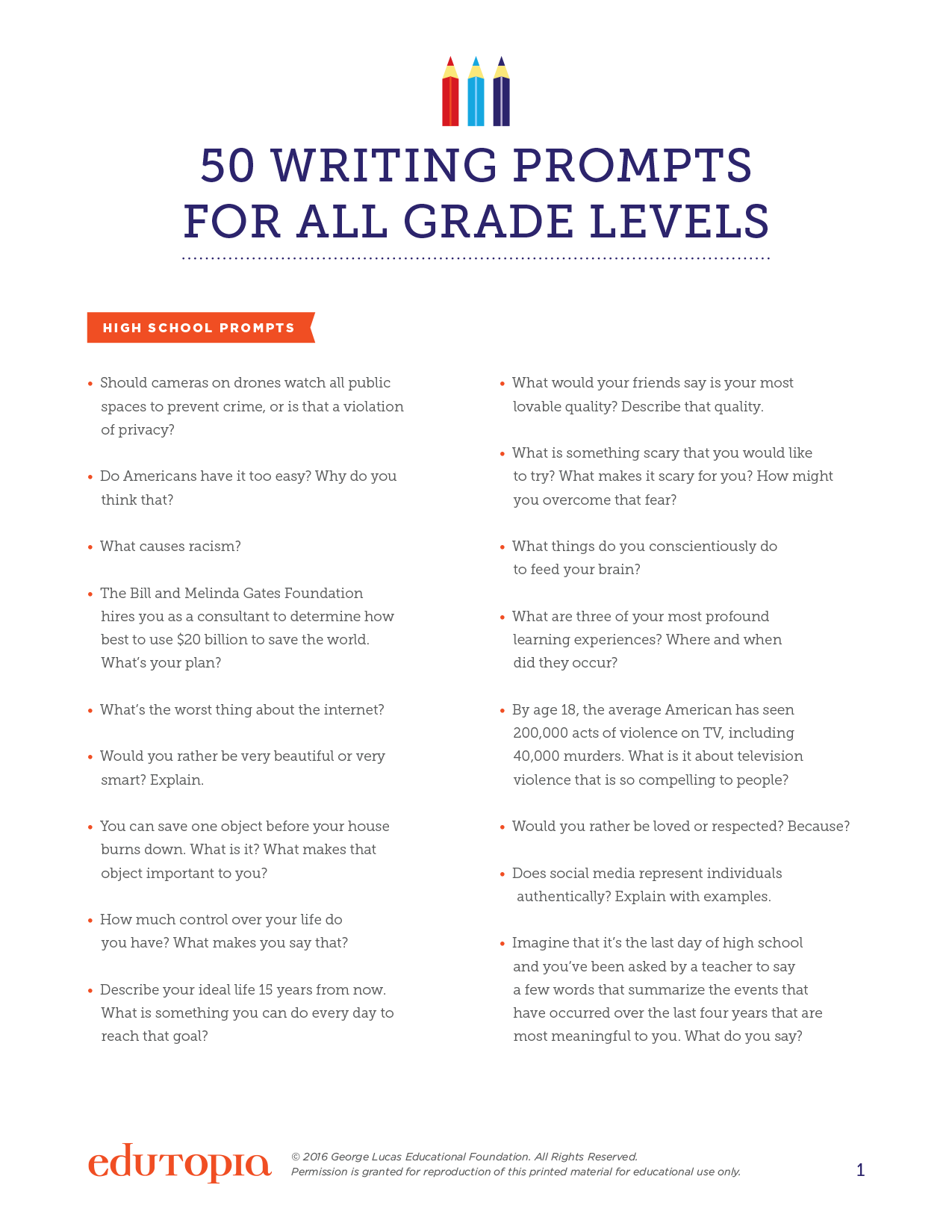
After having students complete a series of writing pieces in response to your prompts, you could have them choose their favorite one and turn it into a longer piece. This works especially well for fiction, narrative nonfiction, and free verse poetry. Or you could use your selected series of prompts as a warm-up—a way to get the creative energy flowing—for students who are about to begin a longer writing assignment.
This approach is all about idea generation, and it’s also a great way to help get students unstuck.
5. Have students read their works in progress to each other
Invite them to read their drafts to partners or small groups so that they have a built-in audience. This increases the stakes a bit, which is always helpful. If done regularly, sharing their works in progress also allows students to see what parts of their writing receive positive reactions (smiles, laughs, gasps, etc.). And perhaps most important, it helps elevate the importance of the messy, exciting, infuriating drafting process—rather than elevating only the final product.
In an organic way, these approaches help writing to become more enjoyable for your students—and the teaching of writing to become more enjoyable for you. Students will naturally find themselves wanting to write more, and also to do so with greater effectiveness. Meanwhile, you’ll find yourself taking more and more pleasure in reading and responding to their work.
This reciprocal, symbiotic energy will begin to permeate the classroom, and in the process, you’ll equip your students with skills that will continue to serve them well beyond your class.