Teaching Grammar With Wordless Picture Books
Students with dyslexia and other language-based learning difficulties can benefit greatly from activities that integrate oral language.
Your content has been saved!
Go to My Saved Content.
As a dyslexia therapist working with students in kindergarten through second grade, I know that many of my students have strong ideas but struggle to generate complete, grammatically correct sentences independently.
Young students, particularly those with dyslexia and other language-based learning differences, lack opportunities to organize those ideas into language. This realization transformed the way I approached grammar instruction in my classroom.
With limited time during intervention sessions, I initially relied on grammar worksheets to teach sentence structure. Although students could complete the isolated exercises, they rarely transferred those skills to their oral language or writing.
I realized that grammar needed to be taught within authentic contexts rather than as disconnected exercises. I needed an activity that would naturally integrate oral language, grammar, reading comprehension, and writing into a single instructional approach.
I found the answer in wordless picture books. Without text to guide the story, wordless picture books are particularly powerful because they foster oral language development, which serves as the foundation for literacy in the early grades. Oral language supports vocabulary, reading comprehension, and written expression—and learning to generate complete sentences is a critical part of that development.
As students describe characters, actions, and events, they practice organizing their thoughts, applying grammatical structures, expanding vocabulary, and communicating ideas with clarity. These oral language experiences naturally transfer to reading and writing because students who can confidently say a complete sentence are better prepared to read, comprehend, and write one.
And the best part: The lesson design and implementation is simple.
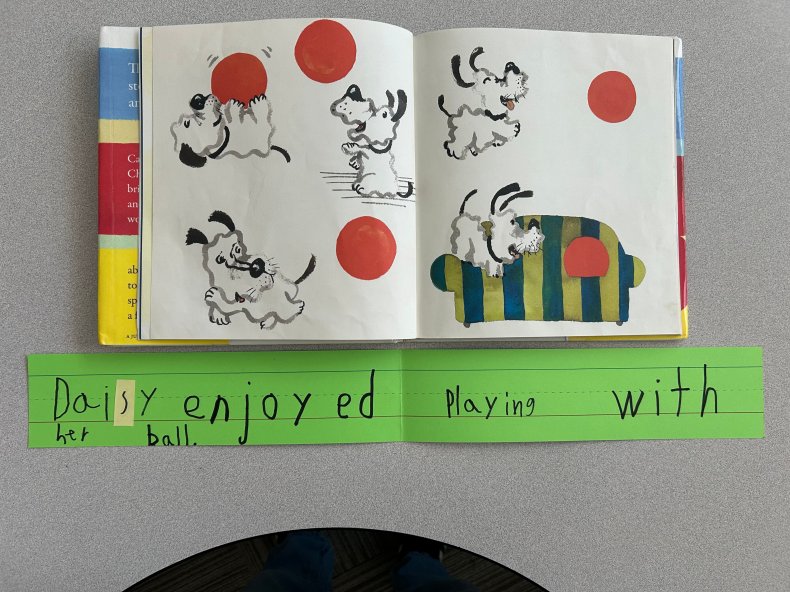
How to get started
Select a picture book with no (or only a few) words, and pictures that are large and can be seen by the students. The pictures should clearly tell a grade-appropriate story. Discuss only one page each day.
Before you start the activity, gather materials such as part of speech cards (displayed in a pocket chart for referencing), chart paper, sentence strips, students’ writing journals and pencils, markers, and tape to cover any writing errors.
Hold the book as you would when reading aloud to the class. Sit students close by so they can see the book easily. Read the title and introduce the author and illustrator of the book to students. Ask for predictions about the story.
Turn to the first page and ask students to describe what is happening. Select one sentence shared by a student and write it exactly as it was stated on a dry-erase board or chart paper so everyone can see.
Here’s a sample of what the exchange might sound like, along with what actions the teacher might take.
Teacher: I heard someone say, “Dog plays ball.” I am going to write that on the board. Let’s think about this sentence. What can we do to revise this sentence to make it more of a complete thought?
Student: Put the dog’s name.
Teacher: Oh, you thought about the title of the book and connected the name Daisy to the dog in the story. Daisy is the name of a specific dog, our main character. (Show visual cards for common and proper nouns.) Is “Daisy” a common noun or a proper noun?
Student: Proper noun.
Teacher: How do I write the first letter of a proper noun?
Student: With a capital letter.
Teacher: (Write the revised sentence under the original sentence.) I am going to write “Daisy plays ball.” And I made sure Daisy’s name has a capital D because it is a proper noun. Are there any other changes we can make?
Student: Add “with her ball.”
Teacher: By adding the word “with,” we have made a prepositional phrase. (Show prepositional phrase card.) This prepositional phrase tells what Daisy is playing with. I will rewrite the sentence: “Daisy plays with her ball.”
Student: But the picture shows her playing with her ball a lot.
Teacher: What is a word we could use to describe something you like doing?
Student: Like a lot. Lots of fun. Enjoy.
Teacher: “Enjoy” is an excellent word choice. I am going to use the word “enjoy” in past tense, so the new sentence will be: “Daisy enjoyed plays with her ball.”
Student: No, change “plays” to “played.”
Teacher: “Daisy enjoyed played with her ball.”
Student: No, it’s “playing.”
Teacher: I am going to write, “Daisy enjoyed playing with her ball.” Is that a complete sentence?
Student: Yes.
Teacher: Does that describe what is happening in the picture?
Student: Yes.
Teacher: Write that sentence down in your journal. I am going to ask some students to come and write that sentence on our sentence strip. Tomorrow, we will reread our sentences and continue to write our story about Daisy.
Rich grammar discussions
This approach allows students to gradually become the authors of the story by generating and writing the text in their own words. Each day, students revisit and reread the sentences they have written, which strengthens fluency while reinforcing sentence structure. Although the original focus is simply to create a complete thought, begin with a capital letter, and end with correct punctuation, lessons can quickly expand into much richer grammar discussions.
As students generate sentences, opportunities naturally arise to discuss proper nouns, possessives, plural nouns, subject-verb agreement, conjunctions, verb tense, and adjectives.
Using wordless picture books in this way makes grammar instruction interactive, authentic, and deeply connected to oral language, reading, and writing. It allows teachers to move beyond worksheets and create opportunities for students to talk, think, compose, and revise in ways that strengthen both language development and literacy outcomes.