An Approach to Structured Literacy for Older Struggling Readers
Teachers can use AI to generate age-appropriate leveled texts that encourage reading skills development.
Your content has been saved!
Go to My Saved Content.
In my ninth-grade reading class, a boy looks endlessly at the passage he has to analyze. Other students in the class have moved on to discussing the content, but he is stuck. What happens to this student when the resources given to teach word learning are uninteresting and geared toward younger children?
Generally, when students reach middle school and high school, they stop learning to read and switch over to reading to learn. However, many students still need targeted phonics, word learning, and morphology instruction. The problem is, there aren’t enough resources to support these areas of learning.
Lately, I have worked with teachers to develop an approach for explicit foundational skills in phonics instruction as well as opportunities to read for meaning. I find that using artificial intelligence (AI) is a very helpful tool to support this process because it saves time by quickly generating material.
Data Drives Instruction, but Comprehension is the Heart of Learning
Start with assessment first in order to identify students’ reading levels. I typically use a combination of an informal reading inventory and spelling inventory to gather information on decoding, fluency, comprehension, and spelling ability. This data helps to identify learning gaps and drive instruction. For example, a student may have difficulty with vowel teams and no solid understanding of morphology.
Once clear about students’ areas of growth, it’s important for teachers to focus on comprehension. Even when foundational skills are needed, comprehension should remain at the heart of instruction. Students need time to engage meaningfully with text to make connections and strengthen their critical thinking skills.
Lesson Implementation for Targeted Spelling Instruction
There are several steps to this approach, including explicit instruction and the gradual release of learning. First, provide explicit instruction for a word pattern—for example, long /u/ vowel patterns (ue, ew, ou, oo). The teacher might say, “Let’s look at different ways to spell the long /u/ sound. Let’s think about words you have seen like blue, grew, group, and moon. What do these patterns have in common?”
Next, using gradual release, move on to guided practice where students sort words such as true, few, soup, and school into different word pattern categories. In this step, students need to explain why a spelling pattern is used. Then, students can fill in missing words to complete a sentence, such as “The flowers began to bl_ _m in the spring.” Ask students to justify their thinking and why they selected “oo.” Where have they seen it? You’re looking for answers such as, “I have seen it in words like moon and food.”
Finally, students read a short passage where the word pattern is used in context. The passage should be of high interest to foster a meaningful experience. Follow this up with a quick comprehension check, such as, “What is the main idea? Do you agree or disagree with the author’s perspective?” After students read for meaning making, have them return to the text to highlight and code words with the particular spelling pattern that is being targeted.
Over time, engaging in this activity reinforces orthographic mapping, which improves both reading fluency and spelling. To determine growth, teachers can use formative assessment to monitor student responses in targeted groups, along with biweekly teacher-made spelling pattern assessments.
Leverage AI to Produce Leveled Texts
A huge challenge for this activity is finding texts that can be decoded and are age and reading-level appropriate. Through the use of AI, this issue can be conquered. AI can be prompted to create a passage that incorporates a specific reading level, spelling pattern, topic, word count, etc. You can tailor this to your students’ needs.
A sample prompt: “Can you please make a highly engaging passage about 650 words for the long o pattern at the third-grade reading level that would appeal to a group of middle/high school struggling readers. Can I have three inferential thinking questions at the end?”
Keep in mind, this generated text will still need to be edited.
Sometimes, re-prompting is necessary when the output doesn’t match your request: “This passage is actually higher than third-grade reading level. Would you please lower the reading level? Would you please include the lesson?”
AI-generated material usually needs to be revised rather than using it as-is. Review and edit passages before giving them to students. Passages need to be checked for spelling, readability, appropriate content, and clarity. The following are some questions to ask as you review AI outputs:
- Are the spelling patterns correct and appropriate?
- Is this the student’s correct reading level of _____ grade?
- Is the topic appropriate?
- Is the topic engaging for this level of learners?
- Does the text support the comprehension skill addressed (if applicable)?
Here is an AI-generated text that I created with ChatGPT:
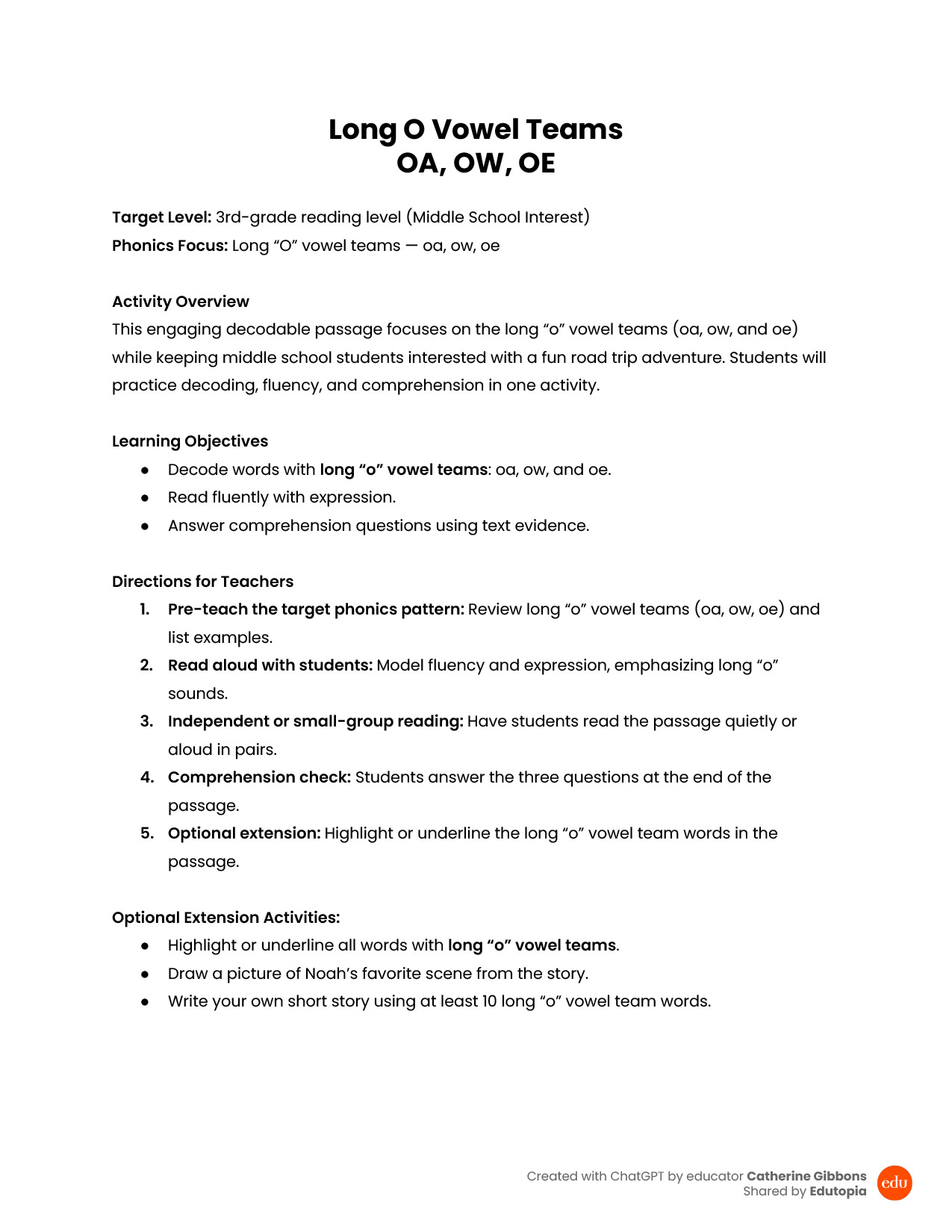
Once the passage is generated, I read through it to make sure that it met my prompts. I’ll also run it through a readability check using Microsoft Word. If something is not met, I will re-prompt the AI tool for a specific update. This process takes about 20–30 minutes, depending on how well you prompt AI.
Keep Track of Student Growth
Track students’ progress with decoding, spelling patterns, and comprehension checks to determine if the instructional approach is working.
To determine growth, teachers can use formative assessment to monitor students as they respond to the questions throughout the activity. I also use dry-erase boards throughout the week to determine if students are able to spell the words correctly based on fill-in-the-sentence blanks that are orally spoken. Teachers will also notice growth in writing, which helps to see if knowledge was transferred. For example, you might notice that a student may have confused ew and oo in the past, but starts to write them correctly.
Professional Judgment
There aren’t enough resources out there that specifically support older students with reading challenges, but with the use of AI, teachers can create more targeted materials for small group learning to meet the needs of students. However, AI is only helpful when it is combined with professional judgment. Teacher integrity matters. It takes professional judgment to make thoughtful decisions about what students need in order to adjust and revise materials to meet the needs of the learner.
An AI-generated passage is helpful only if it meets the needs of students for all aspects of structured literacy. Not only does creating these passages allow a teacher to make opportunities for students to engage with word patterns, but also it also fosters automaticity with words to free up students’ cognition for higher-level thinking.
When this happens, older struggling readers can tackle reading tasks with more confidence, since words are no longer the barrier. This also occurs when students learn how to reflect on their own growth in order to be more of an active reader instead of a passive reader. Through reflection, students learn that they can do something, and this confidence helps them to transfer this learning across content and, more important, beyond school to life.