The Difference Between Engagement and Interest in High School Science Classes
Teachers can use these ideas to turn students’ willingness to participate in an activity into something more meaningful.
Your content has been saved!
Go to My Saved Content.
As a physics teacher, I make a deliberate effort to connect abstract and theoretical concepts to real life. When I heard the French teacher across the hall discussing a jewel heist at the Louvre, I realized I could use the intrigue of mystery to build a physics “case” for students to solve. I tasked them with finding the location of each suspect by using an equation, which ultimately determined who might be the thief. My students eagerly engaged with the case, creatively presenting each character’s defense in a classwide debate, and I was happy to see them enjoying physics.
But then I read their end-of-unit reflections. I had asked them to use the claim, evidence, reasoning structure to state their final judgment about the guilty party. Some students used equations to mathematically support their claim, as I intended, but many only obliquely referenced motion. One student stated, “She was innocent because she was just walking by so she claimed she would not be able to catch the bag and if she had, she wouldn’t have been able to reach the exit in time.”
An unfortunately large percentage of students based their reasoning on social interactions and character stories, rather than the underlying physics. “Mattiue Vasuer is innocent because he was just doing his job as a security guard and used his best judgement,” another student wrote.
I found that I had engaged students in an activity, but the activity didn’t produce interest in, or learning about, physics.
The difference between interest and engagement
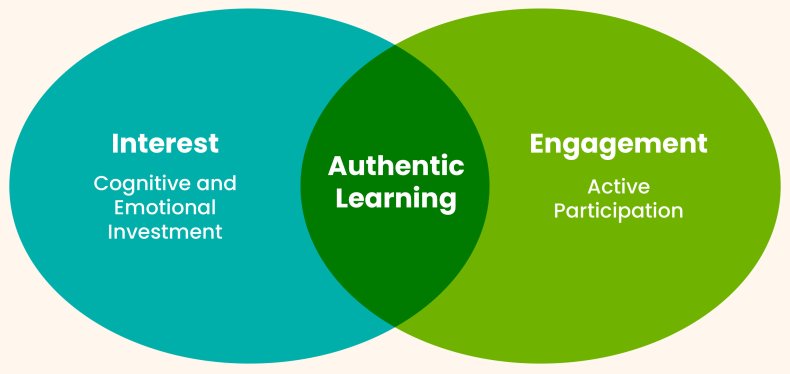
In everyday conversation, we tend to use the words interest and engagement as synonyms. If someone is engaged in an activity, we assume they’re interested in the content, and vice versa. In education, however, these are two distinct concepts: Interest is an internal psychological state that develops and changes over time, whereas engagement involves a set of observable actions.
So what is interest? The definition of interest is a matter of long-standing debate in educational psychology. At the most basic level, interest involves three components:
- Interest is an internal experience that describes an individual preference: “I’m interested in dinosaurs,” versus the fleeting experience of “I’m interested in this right now.”
- Interest provides a deliberate focus of attention over time: “I want to learn more about dinosaurs.”
- Interest involves both thinking and feeling: “I’m excited that I have a deeper understanding of how feathers and dinosaurs are connected.”
As teachers, we use engaging activities to hold students’ attention and pique curiosity, while hoping that the activity helps students develop a deeper interest in the topic.
Encouraging students to become interested
In the most commonly referenced research, interest develops in a series of stages. Recognizing where students are at in their interest development process can help us, as teachers, better tailor activities.
In my case, students typically enter the classroom not interested in, and perhaps even resistant to, physics. It’s my job to “trigger” their early or situational interest and get them hooked on exploring related ideas. I often use discrepant events in science: unexpected occurrences that make students wonder what’s going on and then ask questions that lead them to physics concepts. Current events from the news, such as the Artemis mission or a robot beating human runners in a race, provide student-friendly gateways to engage with content in a way that develops into future interest.
Once students have their interest triggered, I move toward sustaining and nurturing that new internal state. Harnessing positive emotions can be especially helpful in this phase. I often incorporate collaborative group work to build on students’ sense of belonging and their investment in supporting their teammates while working toward a goal. Gamification of lessons, if done strategically and with purpose, similarly nurtures continued cognitive work.
As they develop individual interest—as opposed to simply responding to situations—students eventually begin asking questions on their own. At this point, personalized learning tools become especially powerful. I curate resources and differentiate content based on specific student needs. The trick is to make sure I’m still cultivating interest in physics, not just providing an entertaining vehicle for the content (e.g., using fun worms to make graphs). Individual interest is still rooted in the underlying concepts of motion.
The school year is short, so students often leave our classrooms before their long-term interests truly manifest. To offset this possibility, we can showcase examples of individuals whose interest led them to careers or success. I like to share my own journey into engineering: My interest was sparked at a young age by reading about the fictionalized version of real-life efficiency expert Frank Gilbert, and his wife Lilian, in the book Cheaper by the Dozen. Teacher self-disclosure can foster both connection and interest.
Telling the difference between student engagement and interest
I know my students are engaged because I see them gathered around the activity I’ve designed. I know students are interested when they return the next day with a desire to learn more. When you consider whether your lessons are developing interest versus simply engaging attention, ask yourself:
- What questions are my students asking? Do they want to know what’s on the test or why the phenomenon is occurring?
- What do my students remember? Do they tell their parents at night about eating “moon” Oreos or about learning about the lunar cycle?
- What connections are my students making? Are they simply completing the activity in front of them, or are they able to relate the activity to the broader content and their lives?
- What happens when the activity ends? Is their curiosity satisfied, or do they continue wondering and asking new questions on their own?
The psychology of interest challenges us, as teachers, to rethink our lesson design process. Rather than focusing on how to make something fun, we can more thoroughly consider how to bring students back to an idea over and over again. We want our students to continue to engage with content beyond the classroom, perhaps even into a future career. Interesting lessons are what compel special moments many years later, when a former student says, “You made this interesting to me!” That makes all the effort worth it.