Using Project-Based Learning to Teach Students How Local Government Works
High school students can develop their own community policies to learn how the legislative branch of government functions.
Your content has been saved!
Go to My Saved Content.
I originally created the Legislative Local Policy Project to help my students dig deeper into the legislative branch. Teaching the legislative branch from a textbook standpoint using only PowerPoint presentations and worksheets not only was boring, but also did not help the students relate to the information.
When I learned about project-based learning (PBL), it changed my whole outlook on teaching. PBL showed me not only that there were other ways to teach the legislative branch, but also how to make learning more interesting for students by working with issues that affect their day-to-day lives in some shape or form. I hope these real-world connections will one day help them become active citizens in our democracy.
Introducing the Project
When introducing the project, I start by having a conversation with my students about issues affecting our county. Students like to bring up topics like the school dress code or the new phone policy, and while these are great starting points, they only scratch the surface. I encourage them to move beyond high school issues and look at issues in their community. As they begin researching, students find topics such as housing shortages, gun violence, school safety, and other local issues.
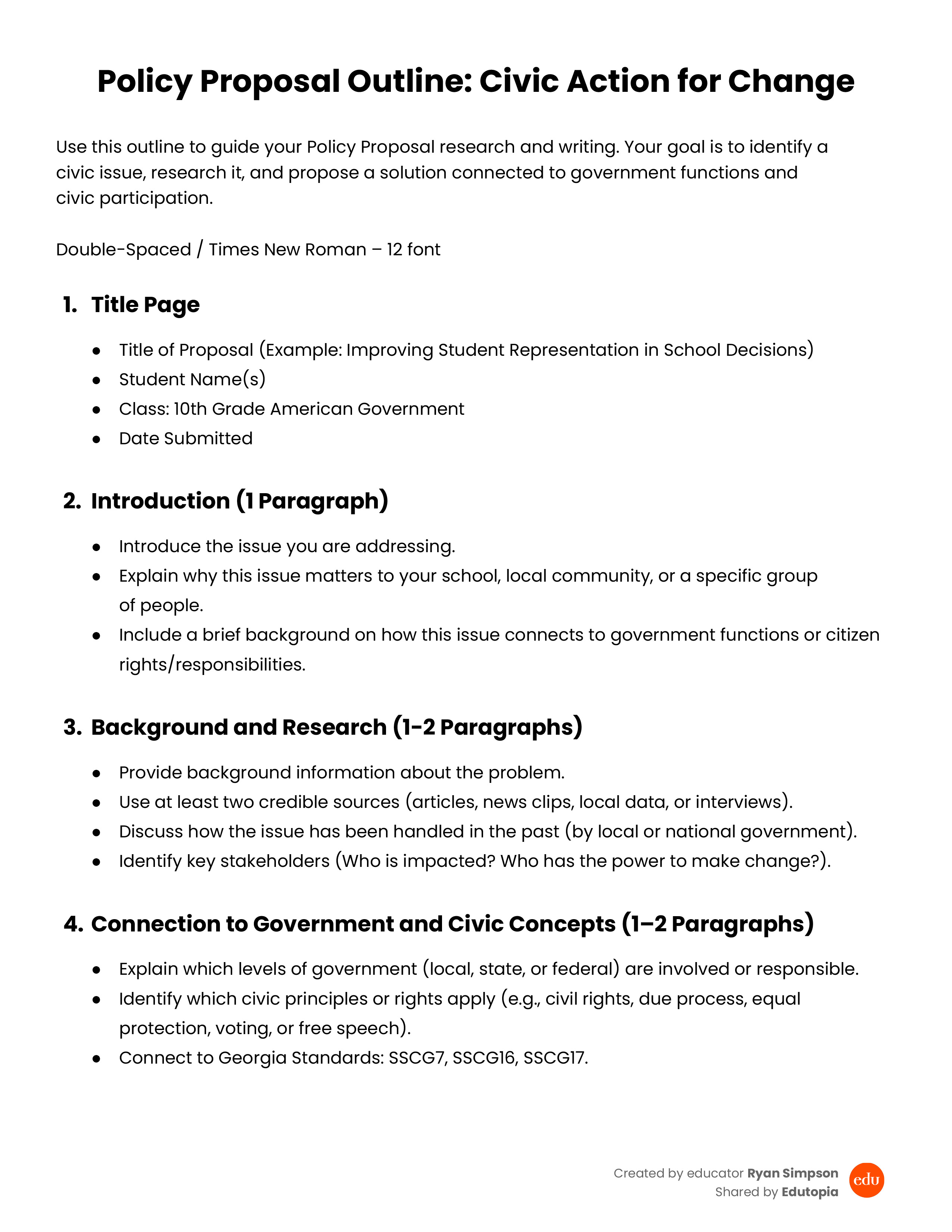
For this project, students can work independently or with a partner. Researching a community issue and developing a policy proposal can be a lot—especially for 10th graders who have little experience writing research papers—so I have found that partnership works best for this lesson. To help guide them through the process, I provide an outline, featured below, that breaks the policy proposal into manageable sections. This gives students a clear starting point while still allowing them to take ownership of their research and proposed solutions.
Working on the Project
Once students decide on an issue, I approve their topic before they begin writing their proposals. When approving topics, I look at whether the issue affects our school or community, connects to government, and allows students to develop a realistic solution. My aim is for students to choose something that interests them, but I also want them to understand that their proposed policy should be practical. For example, if a student wanted to make homework illegal across the U.S., I would encourage them to narrow their focus to something more realistic, such as proposing a change to our school’s homework policy. My goal is not to discourage their ideas, but to help them understand how policies are developed and implemented.
In their introduction, students identify their issue, explain why it matters to their school or community, and connect it to government functions or citizens’ rights. From there, the outline walks them through six additional sections, in addition to a works-cited page and a visual component (a poster, slide show, or infographic) to present to the class.
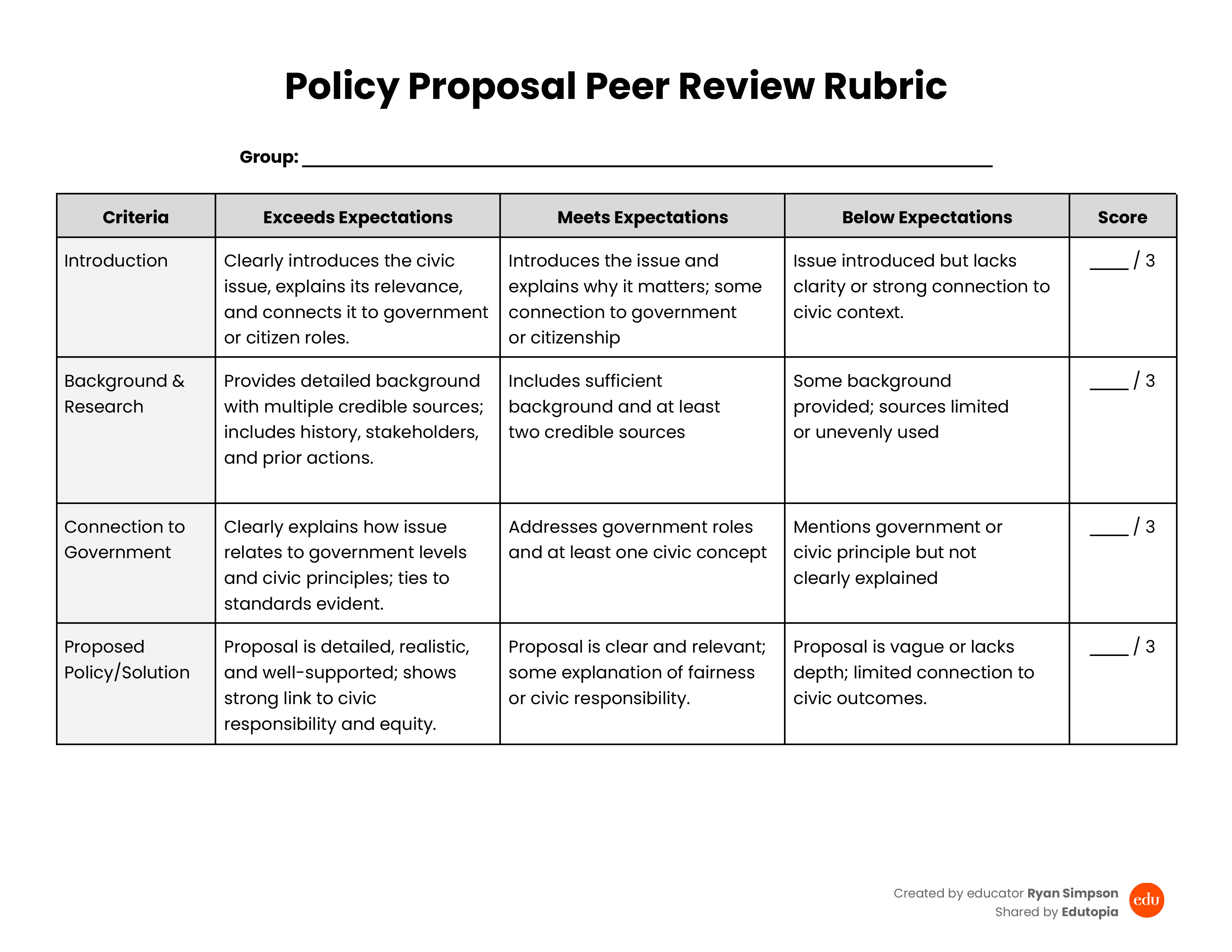
Before students begin working, I go through the outline with them, explaining what is expected in each section. I encourage students to keep the outline in front of them and check off sections as they go to stay organized. Students have four class days to complete their proposals and visuals. During this time, I meet with students and groups to check their progress, answer questions, and help them determine whether their proposed policies are realistic. On day three, students use the peer review rubric below to provide feedback to one another, allowing them to make revisions before submitting their final proposals on day four.
As an example, one group’s topic focused on the lack of affordable housing in our county, and they suggested that local government provide land or tax incentives to builders who build affordable homes. The students also suggested partnering with community groups to repair older homes.
Of course, not every student is always interested in government, and there are always a few who struggle to stay engaged. Before they write off this assignment, I always hype up the fact that they get to choose their own topic and tell them to think about something that they feel strongly about. Recently, we had a student pass away from gun violence. Because of this tragedy, many of my students this year chose gun violence, including the ones who are not normally interested. I believe letting them work with partners also helps, since they have someone to bounce ideas off. If students still struggle to find a topic, I always research three to five topics myself and let them choose from one of those topics.
Presenting to the Class
When it comes time for students to present their proposals to the class, they use the visual component of their project to guide their presentations. The visual component should show the problem, their proposed policy, the actions needed to implement their policy, and the expected impact. Creating a visual teaches students that they do not have to read word for word from their paper to get their point across and helps build communication skills.
While each group presents, the rest of the class is encouraged to ask questions about the presenting group’s topic. Although no student has taken their project further than the classroom, I do offer extra credit for them to submit their proposals to local representatives to see if they get a response.
Students get one overall grade for the project based on their written policy proposal and visual presentation. I use the same rubric for grading that the students use for their peer review. This allows students to understand my expectations, receive feedback, and make improvements before they get their final grade.
A big difference I have noticed with this project is student participation. Students who normally have almost no interest in taking notes or completing worksheets actually get involved and complete the assignment. I was never a teacher who relied only on textbooks, but this project’s success has pushed me to try other classroom activities, like mock court cases, instructional carousels, and student choice boards.
I have found that when students are up and moving, making their own choices, and doing something other than listening to a lecture, they tend to learn more and think beyond the basics. Giving students an outline to follow, while letting them choose their own topic, can make a big difference.