Using Poetry to Strengthen World Language Students’ Understanding of Grammar
Teachers can move beyond conjugation charts to help students recognize verb patterns, build literacy skills, and engage deeply with literature in the target language.
Your content has been saved!
Go to My Saved Content.Demystifying conjugation is one of the more challenging and exciting parts of my Spanish classes. The present conjugation alone is complex, varying simply based on the speaker. When I introduce past tenses, my students may feel like I’m changing the parameters of time and space.
The process I developed for students to analyze the past imperfect in Spanish is similar to the process I also learned from my French professors to analyze verbs in music and novels. I teach this process of close reading for word patterns through short literary texts because it has allowed me to read complex ideas in other languages, while still learning many new words and slowly developing my mastery of their spoken form.
Why Poetry?
After some isolated practice writing conjugation charts, playing memory games, and the usual fill-in-the-blank exercises, I want my students to experience observing language in an authentic literary context.
This requires some intentional scaffolding because high school students in my Spanish I and II have limited vocabulary in the target language, and they are just starting to develop deep experience with reading literature in their native language. Poetry is short, often very stylistically structured, and patterned. It’s also a genre I have taught as an English teacher to help language learners or struggling readers build foundational literacy skills that help them tackle more complex literary texts in the secondary classroom.
Integrating poetry in my classroom has been a joyful experience because it allows students to analyze a manageable chunk of text and have an in-depth conversation in only an 80-minute period. For high school students, poetry in a new language provides a rigorous cognitive challenge while they are still learning the foundations of the target language.
We know that context for language is important for teachers, but for students, working in an authentic context is still an intimidating process. So I integrated poetry, expecting some reluctance from students, but they were eager to learn through a creative activity.
Annotating the Poems
In selecting poems, I took the opportunity to teach my students about a 17th-century cultural icon in Mexico and throughout Latin America: Sor Juana Inés de la Cruz. I selected two poems of hers that used present, past preterite, and past imperfect verb tenses to form a clear rhyming pattern at the end of the lines.
I start this process with students on paper to prevent them from using translation tools and AI in the beginning. This helps them engage with the literacy processes of identifying words they know and don’t know, as well as decoding cognates.
I have students follow a four-step process:
1. Circle all the imperfect tenses
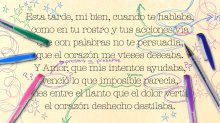
In Inés’s poem “Esta tarde, mi bien,” I asked students first to circle all the imperfect tenses they could identify. For example, here is the first stanza:
Esta tarde, mi bien, cuando te hablaba,
como en tu rostro y en tus acciones vía
que con palabras no te persuadía,
The more advanced students immediately identified the use of the “-aba” and “-ía” at the ends of the lines.
Other students identified them with some additional prompting. I asked them, “Where do rhymes typically occur in a poem in English?” and then, “So if all the imperfect tense verbs end with a similar letter pattern, where do you think the author might place those?”
Translating the imperfect tense is difficult for students, but identifying the grammatical pattern is very doable. It is one of the more reassuring language patterns for students because it is the rare occasion that language works like a scientific formula.
2. Change colors
After students identified the imperfect tense, I asked them to circle the verbs that were left in a different color and label them preterite or present. “What do you think these are? Do they follow other patterns you know? Label the other tenses you notice.”
venció lo que imposible parecía,
pues entre el llanto que el dolor vertía,
At this step, students begin applying the skill of identifying patterns in certain letters and accent marks used in many past preterite conjugations. I guide them through distinguishing between words that may look like verbs but are really adjectives or nouns.
3. Identify cognates
The next step is cognates. Students highlighted those words that clearly resemble words they know in English:
“como en tu rostro y en tus acciones vía”
“venció lo que imposible parecía”
I then asked them to take a step back: “Do you think any of the cognates you identified could be ‘false cognates,’ meaning they do not share the same definition, but do share a root word and similar spelling?” Students began the inquiry process, translating these cognates and comparing definitions that fit.
Some antiquated words also emerge in the poetry, such as “tus acciones vía” instead of today’s “veía,” which helps students also see the historical changes of living languages in action.
4. Collaborate with peers to translate
Next, I had students collaborate to translate the poem line by line without technology, using the vocabulary they know and underlining the words they do not yet know. You can instead assign each group one stanza to move faster through this step. After some productive struggle, most students have a workable translation, so they prepare to start the online research process to finalize their translation.
At this point, students used Google Translate to find the definition that best suits the context. I provided resources like the Cambridge English Dictionary and briefly explained how to identify the best definition based on parts of speech and context in the poem. I circulated and supported students one-on-one as they went through this process.
At the end of the lesson, we spent some time discussing: What does the poem really mean beyond its literal translation? This is the same question students face in their English classes.
We stepped away from technology again, and I asked them to think very broadly, as one would during a first reading of any poem. What words stand out? What kinds of emotions do these words evoke? How would you describe the tone in one word? How would you describe the theme in one word?
I asked them to first discuss this in a group before shouting out potential answers that the whole class might accept as the single answer. I avoided giving them my own interpretations and let them engage in the creative process in groups.
After this activity, I observed students feeling more confident in their translations for future project-based scripts, presentations, and written work. While the conjugation charts they memorize are helpful for much of the year, students showed enthusiasm for understanding a text with complex emotions and meaning. When they arrive at those strategic quizzes and presentation assessments, their study skills have improved and thus their ability to demonstrate proficiency. They learn that they do not need to memorize every single iteration of the verb, but rather to understand the patterns and use those to create more versions of that same verb in new situations.