Exploring the Science of Flight With Model Rockets and Airplanes
These hands-on projects are a highly engaging way for high school students to explore aerodynamics and physics.
Your content has been saved!
Go to My Saved Content.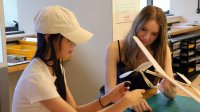
When students launch their first rocket during our school’s flight and design elective, the results are rarely graceful. Some rockets spiral sideways, others take a nosedive, and just a few shoot forward as intended. This is all an intentional part of the process.
The high school flight and design elective at Graded—The American School of São Paulo encourages students to be the authors of their learning process. Rather than going over scientific concepts first and applying them later, students access their prior knowledge, then prototype, test, and revise designs so that they can uncover principles themselves.
In other words, students learn by doing. They partake in hands-on projects that lead to a better understanding of flight through discovery, empiricism, and data exploration. Scientific and mathematical concepts emerge naturally as tools that students use to explain their observations.
The Brazilian writer Rubem Alves once said that “curiosity is an itch in ideas.” This curiosity is the engine of the flight and design course; it pushes students to be autonomous and creative explorers as they move through guided cycles of planning, prototyping, testing, and reflection. Early discussions introduce foundational ideas such as causation, balance, and equilibrium, all of which help students grasp why successful flying prototypes must consider stability, structure, and form.
Below are the incremental steps, resources, and projects that allow students to work toward rocket and airplane models.
THE BEGINNING OF FLIGHT
During the first experiment, students launch small rockets made from straws and paper. The activity, outlined on NASA’s K–12 education website, asks students to change the length of the rocket’s nose cone in order to observe how each modification affects flight. Rather than focusing on finding the “right answer,” the goal of the activity is to identify patterns. To support this exploration, students note simple empirical data such as the distance traveled by the prototype and how it relates to the size of the nose, which varies according to how much the paper tip is twisted. This is students’ initial experience with collecting observational data and examining possible cause-and-effect relationships.
DESIGNING WITH COMPUTER SIMULATIONS
Next, students use the free OpenRocket rocket simulation program to build a virtual compressed-air rocket model. The software—which is very intuitive and requires minimal instruction—allows students to test their design ideas in a digital environment before building physical prototypes. They explore variables like weight, materials, nose shape, fin design, and body length. At the same time, they learn concepts such as stability, center of gravity, and center of pressure.
FROM SCREEN TO SKY
After finalizing their digital designs, students prototype their rocket using printer paper and cardboard fins. They also follow an online tutorial to assemble their own launchers for the rockets. During launch sessions, students test rockets both with and without fins. The variations promote reflections about aerodynamics, stability, and the importance of finding the rocket’s center of gravity/center of pressure.
Through efforts to stabilize their rocket, as well as prompts that encourage curiosity and exploration, students naturally encounter the four forces that affect objects in flight: lift, weight, drag, and thrust. The ideas of cause-and-effect, balance, and equilibrium are revisited in the context of aerodynamics as students interpret the results of their projects. After each launch, students record and analyze the outcomes, organizing their data into tables and graphs. This process helps students rethink their designs, adjust elements, and redistribute weight. Their goal is to improve the relationship between the center of gravity and the center of pressure, so the rocket can fly farther and with more stability.
TRANSFERRING KNOWLEDGE TO SCALE UP
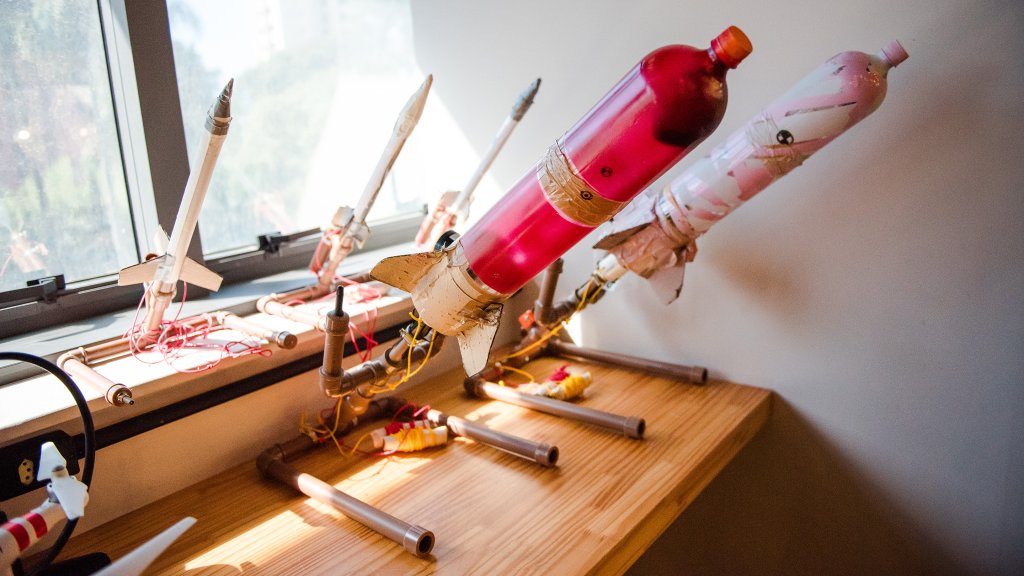
With a foundation in rocket design, students eventually move to more advanced models. They apply what they’ve learned about aerodynamics to build new rockets using PET bottles that are launched with pressurized water. Because these rockets have more power and range, small design flaws are amplified. This model requires greater precision during construction; a deep understanding of symmetry and balance (which are explored in earlier projects) is essential for success.
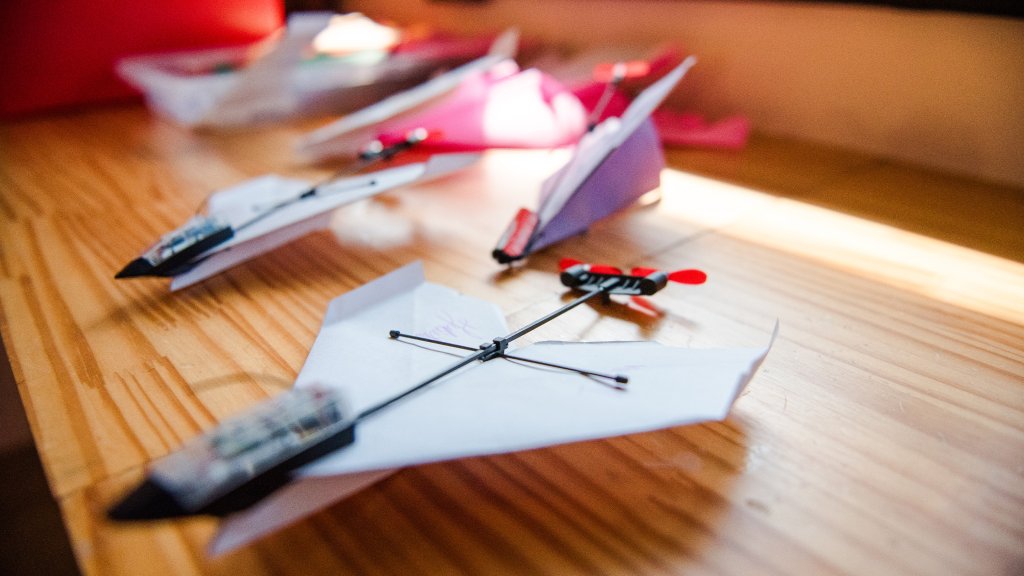
Building on the knowledge they’ve gained through the previous experiments, students pivot to airplane models. Students are generally able to extend their paper-airplane-making skills by attaching the PowerUp 4.0 to their creations, which is a low-cost motor operated via a mobile app. Controlling this model is not a simple task, and balance and equilibrium make a reappearance.
Finally, students implement the concepts they’ve learned from their rocket designs to create a balsa-wood airplane model powered by rubber bands. Students build their models using laser-cut wood pieces, assembling wing ribs and covering them with washi paper to create a design that increases thrust and enables longer flight.
The forces that keep a model in the air are revisited, but this time with thrust generated by the propeller. Because students have already explored similar concepts in earlier projects, the relationship between center of gravity, wing shape, and weight distribution become clearer and more accessible.
Each project revisits the same concepts in a new context, and students transfer what they have learned from rocket design to aircraft design. Their learnings can also be applied in subjects such as mathematics and physics, while supporting the development of practical skills that students can use beyond the classroom.