Fun Math and Science Activities for the Early Grades
Teachers can use students’ natural curiosity about animals to create lessons focused on mathematical concepts and science facts.
Your content has been saved!
Go to My Saved Content.Children between the ages of 4 and 7 usually have a favorite animal from different habitats: domesticated dogs and cats; neighborhood critters like squirrels and rabbits; farm animals such as cows and horses; woodland creatures like deer and foxes; desert animals such as camels and ostriches; river and pond animals like beavers and fish; elephants, rhinoceroses, and gorillas from the jungle or rainforest; arctic and antarctic animals like polar bears and penguins; whales, dolphins, and octopi that live in the ocean.
Most of these animals have eyes, ears, and feet, and some have toes. Each one has unique features that help them travel and survive in their various demanding environments. We humans also have eyes, ears, a nose, hands, fingers, feet, and toes that enable us to travel and care for ourselves in our environments.
Start With a Topic
Consider doing a class math and science project that just focuses on the purpose of feet. I have used the following ideas in preschools with 4-year olds, but it lends itself easily to kindergarten and first-grade students.
Ask students, “How do feet help us?” Feet allow us to move about from place to place, to balance, walk, and run. Ask students to take off their shoes and socks. They can see that their feet are long, with five differently sized toes. When they look under their feet, they can see some padding under their heels. Ask your students to consider how padding is helpful. It absorbs the pounding (and our weight) as we walk. Invite them to walk barefoot and describe how it feels.
Very large animals like elephants can have wide circular feet and padding for traveling long distances. Others, like ostriches, have slight webbing in their feet for balance while running. Students learn that each part of the foot has a purpose. Now, have your students choose an animal with the largest feet—an elephant, a hippopotamus, or a polar bear.
Here are some nonfiction books that students study, with photos of different animals:
- Why Do Elephants Have Big Ears?, by Steve Jenkins and Robin Page
- Amazing Animals series, by Valerie Bodden, Kate Riggs, Mari Bolte, and Christopher Bahn
- My Incredible World picture book series, by Bill and Hope Aicher
- Over in the Jungle, by Marianne Berkes, illustrated by Jeanette Canyon
- Who Lives Here? Polar Animals, by Deborah Hodge, illustrated by Pat Stephens
- National Geographic Kids
Share Specific Animal Facts
Do a bit of animal-focused research and write information about the animals on a whiteboard or easel. I’ve found the elephant, hippopotamus, and polar bear to be the best to start with because they have the largest feet. Have some supplies ready such as tape measures, rulers, yardsticks, string, butcher block paper, an easel, poster board, children’s scissors, and markers.
Here are some interesting facts about three animals that I’ve found to be popular with children, but you can tailor facts based on your students’ selection, keeping size in mind.
Elephant: The adult African bush elephant can be 13 feet tall. Measure the height of your classroom. Do you need to go outside to get to 13 feet? Their feet are the largest of all elephants’, with round front feet that are 24 inches in width and length, and 53 inches in circumference—a good vocabulary word to learn—and their back feet are oval-shaped. They have five toes and walk on their tiptoes. Their feet help them feel vibrations, and they can even communicate with other elephants by stomping on the ground.
Measure 53 inches of string, cut it, and tie the ends together. Put it in a circle so that students can see the actual size.
Hippopotamus: They have large, padded feet that are webbed with four toes that help them glide and swim in rivers up to 20 miles per hour. They “bounce” in the riverbed as they swim. They can weigh up to 8,000 pounds.
Polar bear: Their paws can be 12 inches wide with five toes, which are shaped like snowshoes and help them walk in deep snow without sinking. The bottoms of their feet are “sticky,” which allows them to walk on thin ice without slipping. They can run up to 25 miles per hour and stand up to 9 feet tall.
Use Comparison as the Basis for the Lesson
Now, students can discuss how their feet compare in size with those of the animal that they chose. For example, if students chose an elephant:
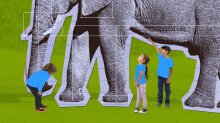
Have each child measure 24 x 24 inches on poster board paper, draw an elephant’s rounded front foot, and cut it out. Ask the class how many of their feet might fit into the elephant’s foot. Have a chart for each child to write down their guess. Then, have children trace their foot on heavy paper and cut it out. Lay their cutouts side by side on the elephant’s foot drawing and see how many can fit.
Consider asking additional questions like, “How many parent’s feet do you think could fit? More or fewer?” “What do elephants’ feet look like underneath? What patterns or textures do you notice?” “Elephants walk on their tiptoes, but how do we walk?”
Extend the Activity With other Features or Conservation Awareness
Create a life-size version of the selected animal. For example, free-draw an elephant, hippo, or polar bear to size on butcher block paper. Lay it out on the floor and see how many children can fit in it—standing up or lying down every which way. Record it on a chart. Have children write about what they’ve discovered. Display their writing for visitors to read, or send their writing home to be shared with their families.
Look through books to see the size of elephants’ ears. They can be as big as 5 x 6 feet and weigh 100 pounds. Draw an elephant’s ear to size on butcher paper. Ask students to guess how many of the children’s ears might fill that space, and do more drawing, cutting, fitting, and counting.
As an additional science element, look at plant books that could relate to the animal selected. For example, with an elephant, consider the alocasia elephant ears plant, whose leaves can grow up to 2 feet wide and look like elephant ears. Keeping one in your classroom can be fun for students to observe and measure as it grows.
Introduce students to conservation efforts that protect endangered animals. Perhaps the class could “adopt” an animal through your local zoo. Or look at websites like the World Wildlife Fund or Oceana.