
Applying a UDL Framework to the Coaching Cycle
This three-phase approach to instructional coaching embraces the fact that educators are lifelong learners.
Your content has been saved!
Go to My Saved Content.
As educators, we often center our attention on students as learners—designing instruction to honor their varying identities, curiosities, strengths, and opportunities for growth. Yet, we rarely pause to apply the same lens to ourselves. The design of successful coaching models embraces the fact that educators are learners as well.
To address this, we’ve developed a coaching model for K–12 educators that is intentionally designed to support educators as learners based on Sharon Feiman-Nemser’s framing of “teachers as learners.”
The model leverages Universal Design for Learning (UDL), a framework for teaching and learning developed by the Center for Applied Special Technology (CAST) that guides the design of accessible, inclusive, and challenging learning opportunities. Applying the UDL framework to the coaching process creates a model for embedding options and supports that nurture professional agency and cultivate more authentic coach-teacher partnerships.
A NEW KIND OF COACHING MODEL
At CAST, we have worked to develop a UDL-infused coaching model grounded in the literature on successful coaching practices and the principles of UDL, with the goal of supporting both coaches and teachers as learners. This work was part of a broader project funded by the Office of Special Education Programs (OSEP) called Project COOL: COaching on Learning. This project aimed to design a coaching ecosystem that supports improved teacher learning in classroom instruction.
Drawing from Jim Knight’s work on coaching, the UDL-infused coaching model is divided into three phases: Plan, Try, and Reflect. The Plan phase includes goal setting to identify a relevant, learner-centered area of focus as well as inquiry to collaboratively develop a structure to reach the goal. The Try phase includes modeling and guided practice with as-needed coach support. Finally, the Reflect phase includes performance feedback and self-assessment by both the coach and the teacher.
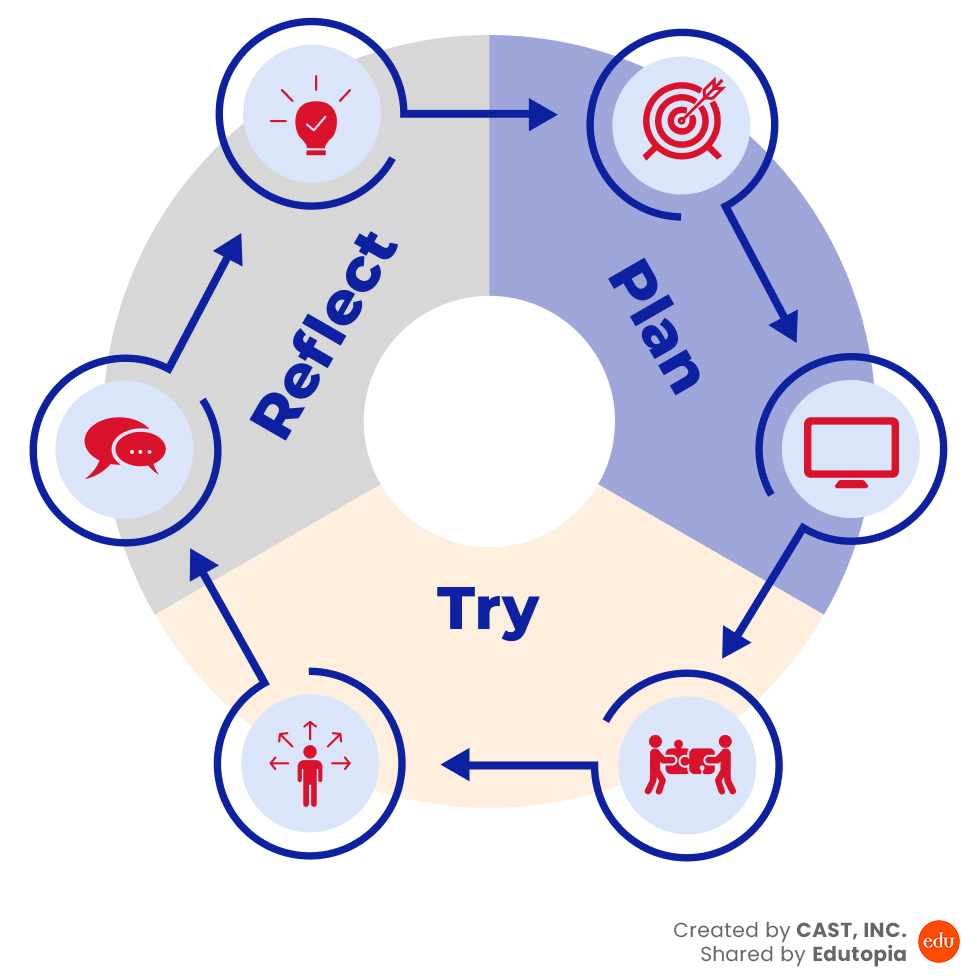
Across each of the three phases, we have drawn from CAST’s UDL Guidelines to proactively reduce barriers and increase access to meaningful coaching relationships.
The plan phase: Teachers and coaches choose authentic goals that align with their own challenges and curiosities (UDL guideline: Design Options for Welcoming Interests & Identities). Further, teachers and coaches collaboratively set goals from multiple perspectives: What aspect of the teacher’s practice do they want to further develop? What aspect of the coach’s practice do they want to further develop? What aspect of their partnership do they want to grow? (UDL consideration: Set meaningful goals.)
The try phase: Teachers and coaches support one another to experiment and practice with different approaches. This phase emphasizes the importance of agency in the learning process and invites the teacher to identify the kinds of supports that will best nurture their growth (UDL consideration: Build fluencies with graduated support for practice and performance.)
The reflect phase: Coaches offer teachers feedback on the implementation of a particular pedagogical move—and teachers offer coaches feedback on their coaching practice. Further, the model prompts self-reflection from both the teacher and the coach on actions to further develop their individual practice as well as their coaching partnership (UDL guideline: Design Options for Emotional Capacity.)
This UDL-infused coaching model is flexible enough to be used in an array of educational settings—and can also be used as a tool to prompt reflection on existing coaching models.
THE UDL-INFUSED COACHING MODEL IN PRACTICE
In practice, this coaching framework might work like this: Mr. Wright, a middle school science teacher, arrives at the coaching session with a challenge he has been wrestling with. His students seem to understand the content during discussions, yet some students are having difficulty demonstrating their thinking through written assignments.
He reflects, “I think I may be asking students to show their learning in ways that create unnecessary barriers.” In this plan phase, he sets a goal to design options for students to express understanding in more flexible ways. Ms. Jackson, an instructional coach, is eager to support Mr. Wright with this goal.
She also shares her own goal of more fully developing the ways she guides teachers to analyze student work. Finally, they decide on a goal to strengthen their partnership: to continue to build more honest, two-way feedback into their work.
In the try phase, Mr. Wright decides to pilot multiple options for students to demonstrate their thinking alongside written responses: visual models, oral explanations, and annotated diagrams. Ms. Jackson offers an array of options to support Mr. Wright with this goal, and he selects examining student work and analyzing classroom video.
He feels that these two approaches would support him to dig more deeply into the ways students are demonstrating their learning across multiple modes of expression. During Mr. Wright’s next lesson, Ms. Jackson gathers samples of student work and captures video so that she and Mr. Wright can examine these artifacts in their next session.
As they move into the reflect phase, Mr. Wright shares specific noticings of students who expressed sophisticated science ideas verbally and through visuals, even when their written language was brief. Ms. Jackson supports Mr. Wright to reflect on how they could continue to work on expanding options for expression in the next unit. Mr. Wright also shares how Ms. Jackson’s prompting supported him to notice patterns in student work and in the video clips.
They conclude this cycle with concrete next steps for continuing to experiment with multiple modes of expression as well as for continuing to develop their collaborative practice.
CONNECTING TO YOUR OWN CONTEXT
This model is designed to be applied across school settings and is a tool that instructional coaches and administrators can use to cultivate and sustain successful coaching relationships that honor educators as learners. When bringing this new model into practice, it may be helpful to dig even deeper into the process. Instructional coaches and administrators can explore the COOL Coaching Modules, a suite of asynchronous learning modules, and the COOL Video Series that offers perspectives on UDL implementation and insights specific to coaching.