Ensuring That Students Correctly Understand the Equal Sign
Many students see the equal sign as a signal to calculate, rather than a symbol of equivalence. Here’s how to clear up that misunderstanding.
Your content has been saved!
Go to My Saved Content.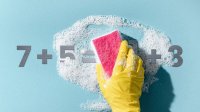
Most pre-algebra teachers know “the box problem.” When presented with 7 + 5 = [ ] + 3, some of my students immediately fill in the blank box with 12. To them, the equal sign is not a symbol of equivalence, but a signal to calculate whatever expression precedes it. If we want learners to succeed in higher-level math, we must move them from this operational view (do something) to a relational view (this is the same as that).
I use the lens of mathematical hygiene to layer my classes with habits and routines that strengthen mathematical understanding and prevent misconceptions from taking root. Just as physical hygiene involves habits that keep the body healthy, mathematical hygiene is a set of practices that keep mathematical ideas healthy and strong over time.
One widely accepted mathematical hygiene exercise is simplifying fractions. While the necessity of simplification depends entirely on the context of your math, teaching this habit early—coupled with a hygienic cadence of practice and review—keeps students’ work clean, prevents algebraic errors from cascading, and maintains a canonical format for clear communication.
The word “equal” is one that can be lost in translation as students develop positive math identities. Here are three activities that promote mathematical hygiene and help students fine-tune their understanding of equivalency.
Semantic Gradients
Research links precise vocabulary usage to academic growth in math classrooms. In addition to reading the equal sign as “equals,” I incorporate phrases emphasizing balance rather than computation, like “is the same amount as.”
Combined with nuanced word study collaborative discussion, an exploration of semantic gradients—small differences in meaning between terms—reinforces this language shift. I have my class work in small groups to sort through related terms along a continuum, ranking words from weakest to strongest as synonyms of “equal.” Groups are given the following list along with time to negotiate an order: “equal,” “alike,” “identical,” “matching,” “same,” “uniform,” “duplicate,” “comparable.”
When students engage with semantic gradients, two things happen. First, conversation explodes. Even students who never, ever participate during whole class activities begin debating fine distinctions between terms. Second, everyone learns from each other, and strategies organically spread across groups. For example, one student described “duplicate” as being “like copy-and-paste on a computer,” and nearby groups quickly adopted the phrasing in their own explanations.
Balance Manipulatives
Math learners often need tactile experiences before they comfortably engage with abstract ideas. Tangible manipulatives like stackable cubes and base-10 blocks provide scaffolds that help students visualize the equal sign as a balance point.
Virtual applets like Polypad provide a free collection of digital manipulatives that I use to create and share customized activities. Using the balance scale in Polypad’s algebra section, I design scenarios in which students must fill in a box with values or objects that make both sides equal. As we drag and manipulate weights, test combinations, and adjust quantities, students immediately see when two sides represent the same amount. Re-creating the aforementioned box problem, learners see how 7 + 5 and [9] + 3 occupy equivalent weight on the scale.
Dot Talks
The tendency for many students to see the equal sign as the stimulus to simply produce an answer stems in part from monodirectional arithmetic, in which the operation is almost always on the left side of the equation (e.g., 4 + 5 = 9). To help students recognize that equal quantities can look different while still expressing the same value in multiple directions across equal signs (not just from left to right), I introduce a variety of equation structures early and often using Dot Talks. I briefly display an image of dots and then ask the class how many they saw. Instead of students counting the dots one by one, the key is for them to describe how they saw the quantity.
As my students share their observations, I record each interpretation of the dot structure and translate them into numerical expressions. I use the following prompts:
- How many dots did you see?
- What caught your eye upon first looking at the dots?
- How did you see the dots?
- Did you group the dots in any way?
For example, one student might see 12 dots as 6 + 6, another student as four groups of 3, and another as 10 + 2. As these representations accumulate side by side, the conversation becomes more of a continuous connection between ideas and shifts students away from viewing the equal sign as a stopping point.
Mathematical hygiene has important implications beyond a single symbol in mathematics. It cultivates classroom norms that reinforce healthy habits of language, logic, and representation. By introducing the equal sign as a relationship rather than a command, students develop stronger number sense and conceptual understanding from the start. This relational view helps algebra feel like a natural extension of ideas they already know, rather than a new and unfamiliar language.