Creating a Curriculum-Based Board Game From Scratch
Instructions for middle and high school teachers who are interested in assigning their students an engaging group project.
Your content has been saved!
Go to My Saved Content.
Though I’ve taught a variety of grade levels, this year presented a new challenge: teaching high school seniors. Going in, one of my top priorities was to make sure students stayed engaged and focused through their final exams and graduation ceremonies. I wanted to introduce a fresh and unique project—something that instilled intrinsic value and a desire to not only attend class, but also work diligently.
Seeking inspiration, I went to a conference where I took a workshop about game-based learning. The workshop centered on the idea that students can learn by playing different types of board games, even curriculum-oriented ones produced by their own teachers. As a lifelong board games fan myself, I was sold. I knew what to do next: design a project where students don’t merely play a game, but create one.
I brought the idea to my colleague Kimberly Rodrigues, and together we created a final project for our senior classes. The main objective of the project was to ensure that students could become innovators. We tasked them with making an entire board game from scratch—something that incorporates the narrative elements of their study materials. In doing so, they demonstrated mastery.
The project ended up being a huge success. My seniors told me they enjoyed coming to school so they could keep plugging away at their board games. I plan to roll it out again next year, and I believe its versatility makes it applicable for grades 6–12, not just seniors.
Creating the Board Game
My colleague and I aimed for this to be a fully intellectual experience; students weren’t allowed to use any technological aspects until the project’s final step. As an introduction, we asked our classes to play and analyze a mix of board games. These are some of the games they looked at:
- Parcheesi
- Ticket to Ride
- Candy Land
Some students were already experienced board game players, while others were unfamiliar with analog games. Setting aside a full day for practice and analysis helped everyone get up to speed. It also provided background information on the typical incentives and structures of a board game, and got their minds churning about their own creative processes. I tried to choose games that were very different from one another, so when students shared their analyses, they could see the myriad game styles that they could integrate into their own projects.
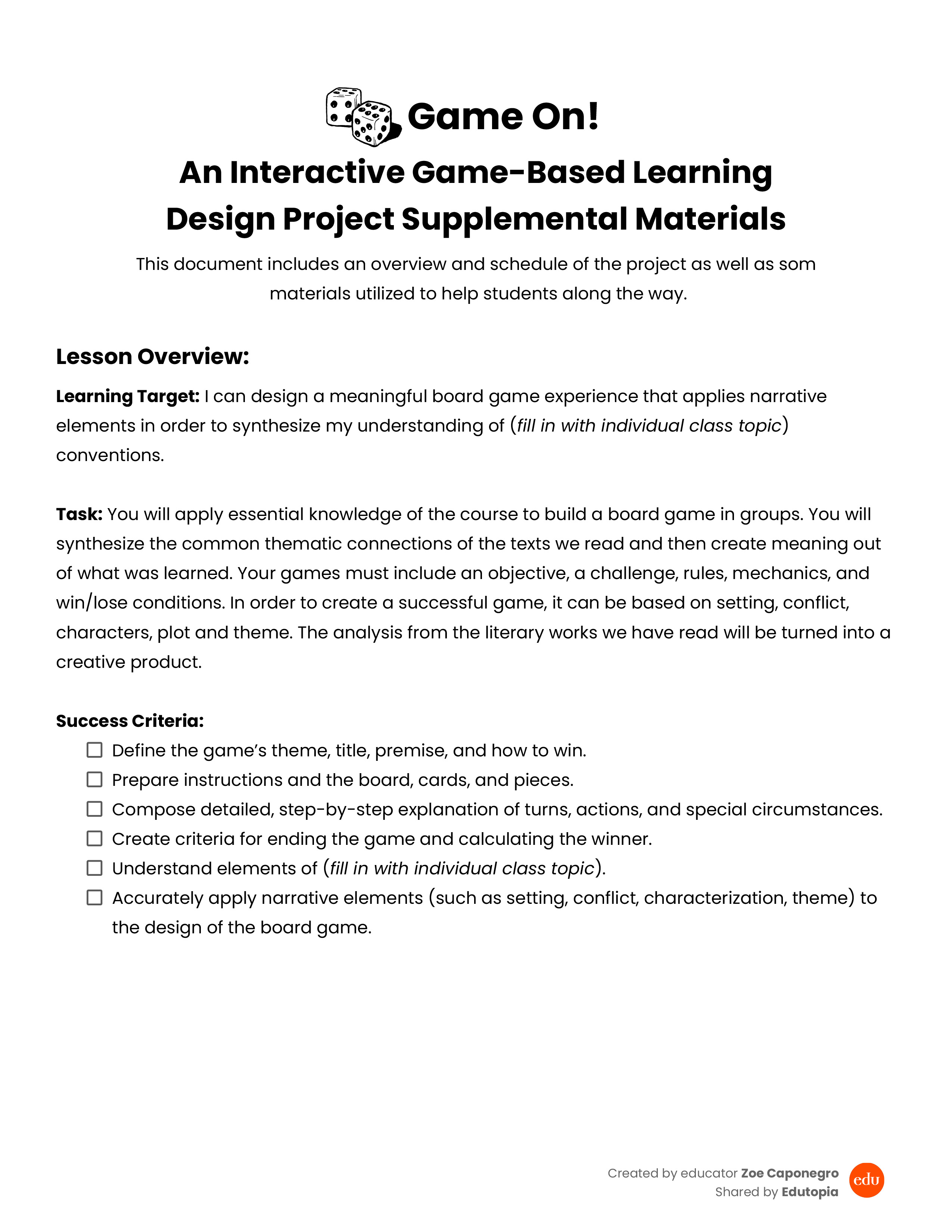
Next, we divided students into teams of four or five and tasked them with using chart paper to brainstorm what their game was ultimately supposed to look like. The game must include the following:
- An objective
- A challenge
- A set of rules
- A set of mechanics
- Win/loss conditions
Crucially, the game needed a compelling backstory related to our coursework (we teach horror and dystopian literature). We told students their games should clearly convey a setting, conflict, plot, theme, and dynamic characters, all of which should be related to what we read and discussed during the school year.
Students were required to delegate tasks among their group members. If a particular student was a strong artist, they might paint the board. If another student was a strong writer, then they might make the instructions manual. After delegating, we gave teams five full class periods to complete their board games.
Students utilized blank board game kits that we received from a grant; however, teachers can instead provide simple materials like poster board, index cards, construction paper, markers, and paint. To make sure that students understood expectations and requirements, we gave them checklists for each part of the creation process.
‘Selling’ the Board Game (and Playing It!)
Rather than calling it a day after the board games were completed, we added a twist. Each team was asked to create a 20-to-30-second commercial, where they had to use persuasion techniques to persuade their classmates (and teachers) to try the game they had made. Students even came up with a (fake) name, price, and slogan for their games.
My colleague and I allowed students to work with AI and other digital tools for this portion only, though we monitored AI usage to make sure it was beneficial and not overdone. For instance, some students prompted AI to create a picture that served as the introduction of their commercial. (To do so, they vividly described the setting of their board game to the AI chatbot.) Other students prompted AI to do a voice-over of their commercial, something that mimicked the tone of a TV advertisement. The final commercial was presented with Canva, which has a wonderful user-friendly video-making tool.
After presentations, it was game time. Students had a blast trying out one another’s board games. Once they had a chance to reflect on the entire experience, including their peers’ contributions, students submitted self-evaluations about their assigned portion of the project. My colleague and I separately assessed each student’s contributions. The same grading process was done for the commercial, too.
Why the Project Works
This project pertains to all types of learners. Many of my students have individualized education programs and 504s; my colleague has English as a New Language classes. Because the board game project has built-in scaffolds and differentiation, it’s equitable and fair for everyone, and a more tactile way to demonstrate comprehension. It especially appeals to visual thinkers, which allows for a more strategic approach to creation and storytelling. And it permits collaboration and communication among the class. My students were invested in ensuring that each piece of the game worked properly, that the rules were clear, and that the overall meaning of the game made sense. Students told me they especially liked the delegation aspect of the project, where they were entrusted to divvy up responsibilities based on their team’s strengths.
Additionally, students were emboldened to be innovative thinkers and effective communicators. Best of all, they were encouraged to create physical meaning out of class material. They were able to synthesize the common thematic connections of the texts we read and created meaning out of what they had learned.