Activities That Build Students’ Feelings Vocabulary
Teachers across grade levels can foster students’ understanding of their emotional states to support interpersonal and academic success.
Your content has been saved!
Go to My Saved Content.
Having a large, nuanced feelings vocabulary is one of the most important life skills we can impart to students. Emotions strongly influence our actions. But if we are unsure about how we are feeling, or if we mislabel our feelings, what we do might not work out ideally. Consider students who are having academic difficulty. Their reactions will be quite different, depending on whether they label their feelings as anger, frustration, challenge, or failure. As the research of Mary Helen Immordino-Yang has shown, emotions are a primary driver (or deterrent) for learning.
We have a natural ability to recognize a tremendous range of feelings in others and in ourselves, but we don’t all put this talent to its fullest use. This is a developmental issue. Building a feelings vocabulary can start early in school life and continue through high school. The idea is to gradually expand the feelings words that students are familiar with and encourage them to use an increasingly wider array of feelings words in their writing and speaking.
It’s also more than a language arts issue—the wider our feelings vocabulary is, the more nuance we can appreciate in relationships. Carolyn Saarni, in her classic work, The Development of Emotional Competence, refers to emotion vocabulary as one of the most central skills in human development. It impacts functioning in school and life, in all contexts of relationships—personal, classroom, lunchroom, bus rides, friendships, roommates, and teammates, and managing the complexities of the workplace, politics, and civic life.
Elementary-Level Activities
In children’s storybooks, the illustrators typically do a fantastic job showing characters’ feelings, whether they are people or animals. As you read aloud to students, stop and ask them what feelings the character is experiencing and how they know (what tells them the character is sad, mad, happy, excited, etc.). Where possible, look also at body language in addition to facial expressions. I have had great success with reviewing the pictures in a picture book before reading the text, in what I refer to as a Feelings Detective game. Without relying on words, the class tries to “detect” what characters are feeling only from the pictures, learning the different “clues” to pay attention to.
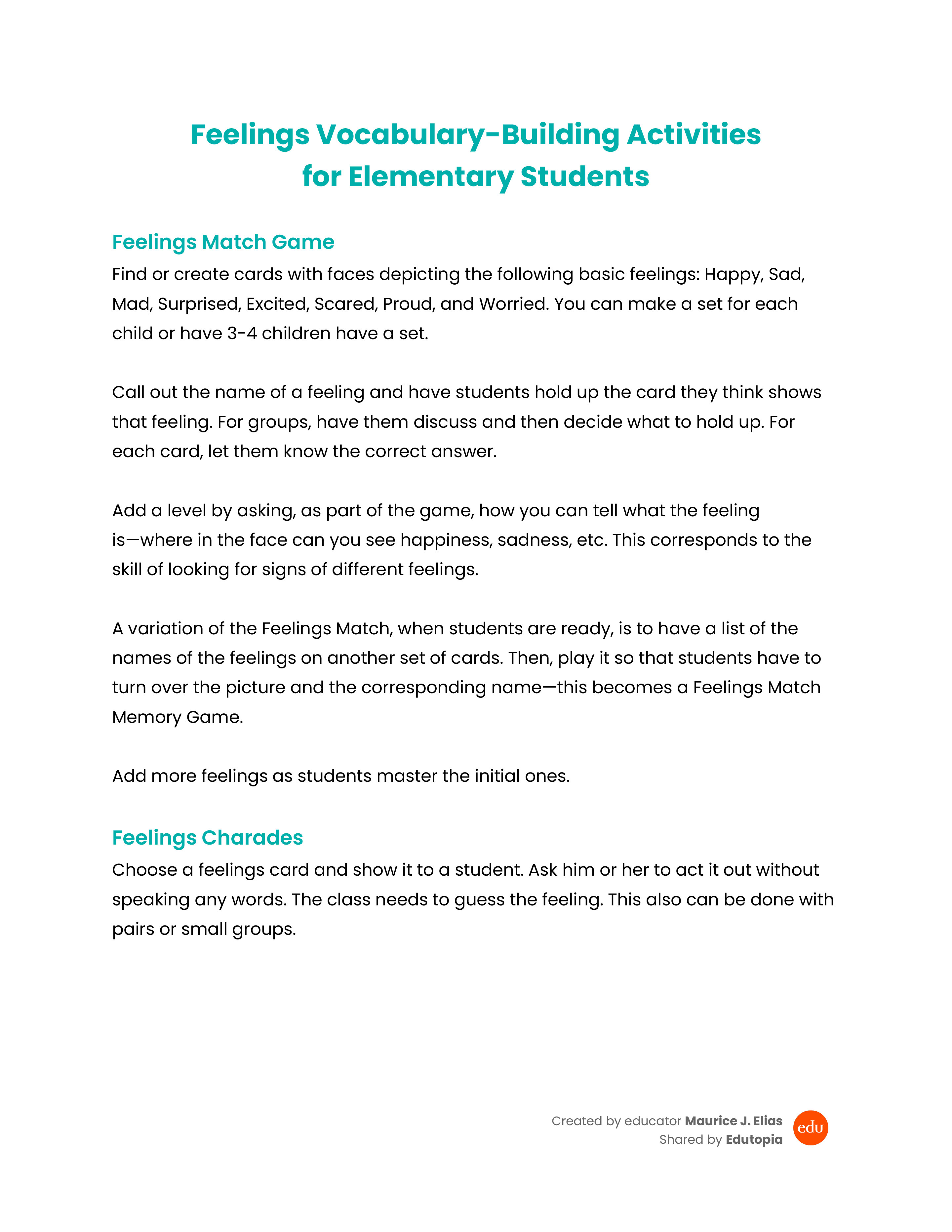
Other activities that build students’ feelings vocabulary at the elementary level are a feelings match game and feelings charades. As children grow up, they spend more time with their peers. That means they have to learn how to read their peers’ social and emotional cues. Based on what they perceive, they can figure out what actions make the most sense to take. But if their vocabulary of emotions is limited, they will not be so accurate in understanding their peers, and their reactions will be more likely to be unsatisfying and/or unsuccessful. This can lead to interpersonal issues that will seem hard to figure out. But we know better: An expanded emotion vocabulary is needed!
Middle and High School–Level Activities
When students try to capture new ways to put their feelings into words, they’re engaging in a task that improves their self-awareness and interpersonal understanding, as well as their reading and writing skills. Writing definitions of specific emotions in their own words and a matching task are two related activities that support building this skill.
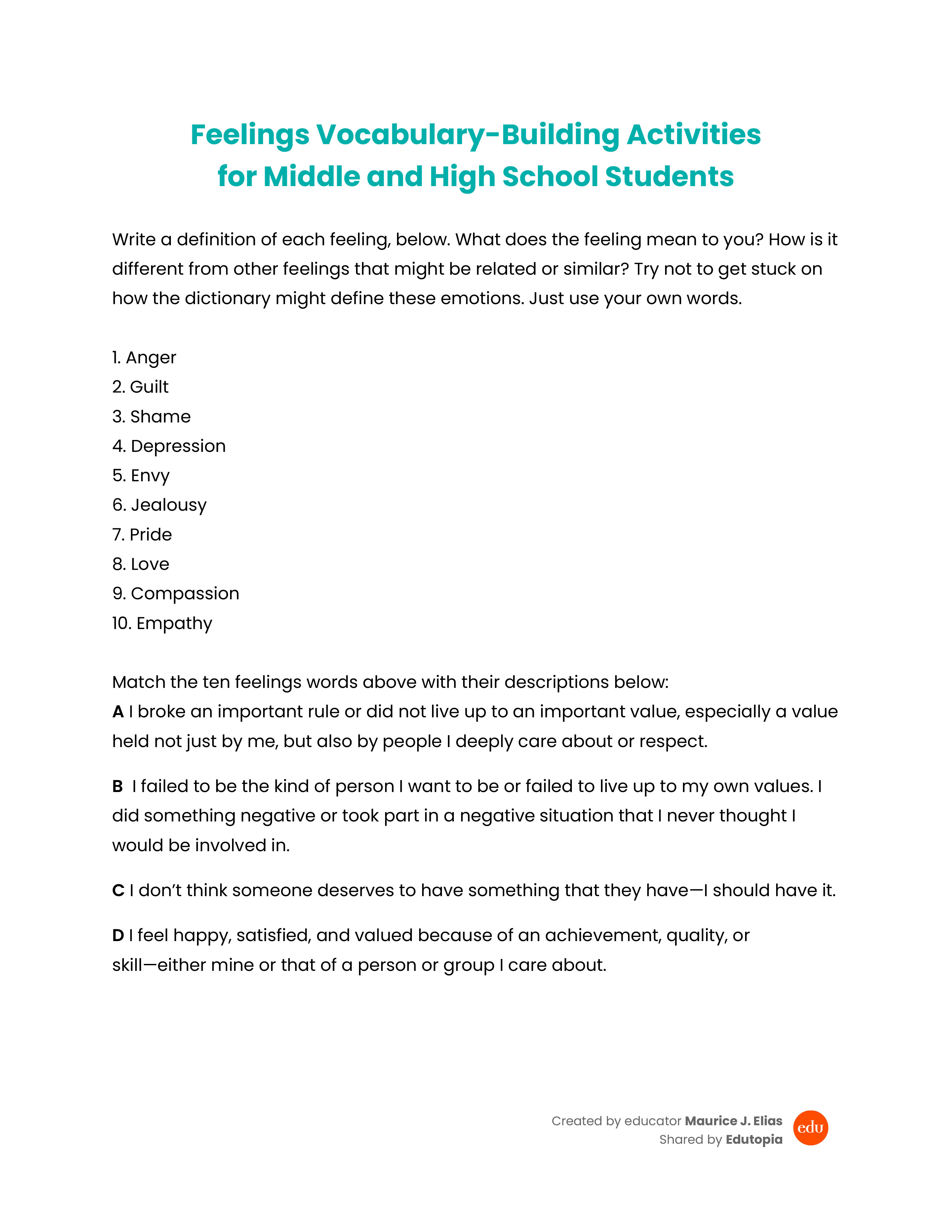
In the first, students are asked to write their definition of a few feelings words. When they’re finished, they can compare their responses to a peer via pair-share. Then, pairs can meet and come up with a consensual statement about their understanding of each term.
One variation is a matching task. Ask students to match up the list of feelings with descriptions of those feelings. They may think there’s more than one correct answer in some cases. Ask them to choose the reason that they think is the closest match. Once completed, the same process of peer discussion and consensus can follow. The difference here is that teachers can share the “answer key,” which can prompt further discussion.
Students might disagree with some of these matches. If so, have them discuss why that might be.
To reinforce expanding students’ emotional vocabularies, encourage them to use more and varied feelings words in their writing. In their verbal presentations, don’t hesitate to ask them if they can be more precise when they use basic terms like sad, mad, and glad. This focus will have payoffs in the depth of their understanding of academic areas. For example, to an increasing degree over the course of secondary schooling, students will read novels with more and more complexity of character development. If their emotional vocabulary lacks breadth and nuance, they won’t see the subtleties in these works. They won’t be intrigued or challenged by what they’re reading, nor will they be motivated to see how it applies in their own lives.
This is even more true in the study of history, where an overly basic and simple emotion vocabulary will reduce most historical conflicts to “good and bad” or “right and wrong.” The lack of emotional sophistication plays out in adulthood through engagement in polarized politics and an inability to dive into the details of issues and work toward compromise, which are solutions with mixed emotional results.