Helping Students Collaborate and Connect From Day One
High school students are better prepared to take academic risks throughout the year when they feel a sense of belonging right from the start.
Your content has been saved!
Go to My Saved Content.
As educators, we know that authentic learning requires a sense of vulnerability from our students—they have to be willing to take some risks and make some mistakes in order to grow. But we also know that this is a big ask from students, especially high school students.
In my classroom, I’ve tried to create a culture where everyone feels safe to take risks, and everyone feels like they are part of a supportive community; and this work starts right from the beginning of the year.
4 Ways to Build Community at the Start of the Year
The following four activities can help reduce anxiety about the upcoming year, offer students opportunities to connect with one another, and help students see that I am part of the community too.
1. Create an interactive syllabus review. At the start of the year, your students are probably going over a class syllabus in every period. While it is important for students to get this information, just reading it to them doesn’t really inspire a sense of excitement for the year.
A few years ago, I shifted to creating an interactive syllabus review activity that not only got students working together, but helped them explore classroom rules and routines more thoroughly. When students know what to expect from their environment, they are better able to focus on learning and take academic risks that lead to growth.
For the interactive syllabus review, I created a scavenger hunt through the syllabus. Students logged on to Google Classroom and found our syllabus, along with a graphic organizer full of questions. Students worked in pairs to find the relevant answers within our class syllabus.
Once students completed the activity, they had a better understanding of our classroom rules, routines, and procedures, and of what we would be learning throughout the year. We debriefed as a whole group to discuss any questions or concerns students had about our classroom.
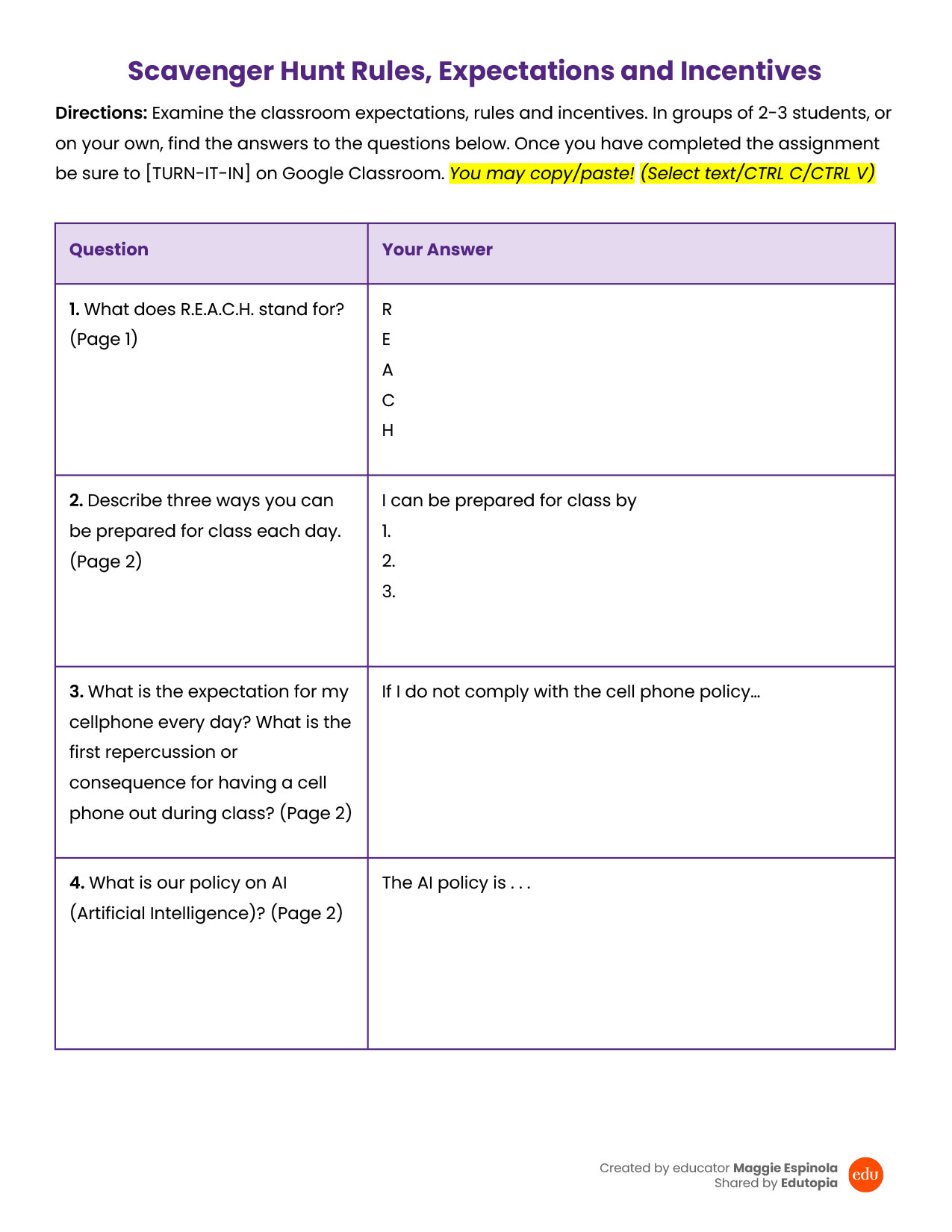
To create your own interactive syllabus review, I recommend asking students to find the information you deem most important for them to understand or the information you want to discuss during a whole group debrief.
2. Learn student names and birthdays. At the very baseline of understanding who your students are is knowing their names. Before my students step off the bus and into my classroom for the first time, I try my best to look up their photos in our school’s database and complete some kind of silly mnemonic code to match a picture to a person. But I wanted to do more to help students feel recognized when they arrived on the first day.
I bought a large wall calendar with all 12 months, and as I worked through my class list to learn names, I also noted their birthdays and added them to the wall calendar.
When students first saw the calendar, they were happily surprised to see that I’d put in the effort to learn their birthdays, but even more important, they were eager to gather around the calendar and see if anyone shared their birthday.
This quickly got students talking to one another. And so, throughout the year, we acknowledge each student on their birthday with a simple song. The celebration isn’t anything major; it just ensures that no student goes the entire day without anyone knowing it is their birthday.
3. Complete hands-on challenges to build community. In my 10th-grade English class, I ask students to do a wide range of group projects and presentations throughout the year. But, before students can feel comfortable sharing their thoughts and taking academic risks with another, they first just need to feel comfortable around their classmates.
One of my favorite ways to build a community that encourages everyone to feel comfortable in class is through completing low-stakes, hands-on challenges.
At the beginning of the year, I put students in groups of four to complete a variety of challenges together. These can include building the highest tower out of index cards or completing a jigsaw puzzle, but I always add an extra team-building challenge.
For the index card tower, students must figure out something they all have in common and write it on the card before adding it to their tower. This helps students build connections with their classmates as they work to beat other groups.
For the jigsaw puzzle, the only student who can touch the pieces is blindfolded and must listen to the directions of the other team members to complete the puzzle—I choose puzzles meant for children around age 6 to make this possible.
This teaches students about effective communication, and it is also such a fun and silly way for students to get to work together.
The key with these activities is that the stakes are low, there is no prior knowledge needed, and students get to learn how to feel comfortable around one another. This then sets them up to work better together when it is time for something with higher stakes.
4. Introduce yourself with a slide, and have students do the same. The last of my favorite beginning-of-the-year activities is to introduce myself to students using a Google Slide deck, and then have them do the same activity.
I create a slide deck in which each slide contains a different subset of information about me: my family, my interests, my goals, etc.
Not only does this help students get to know me, but also it shows students that I will always provide a model for any summative assessment I assign them, whether it is my work, a student sample, or a resource from the web.
When it is time for students to create their own slide deck, I circulate the room, asking students individual questions about their slides as they work. This helps me get to know them and also gives me a baseline of their writing level as they add context to their slides.
Activities like these help establish a classroom community where students feel like they belong and feel comfortable taking academic risks throughout the year—that is the kind of community that helps students truly learn and grow.