
How to Rock Your Parent Conferences
Conferences can be daunting, especially for new teachers, but they’re also a real chance to build connections that support students’ growth.
Your content has been saved!
Go to My Saved Content.Thinking back to my very first parent-teacher conference day, what I mainly remember is how exhausting it was. Even though each conference was only 10 minutes, I was so nervous about each one that I was worn out. All I could think was, “What if I get a question I don’t know how to answer? What if a parent is critical of my work?” I was a new, fresh-out-of-university teacher, so these parents and caregivers were my elders, and I didn’t yet have the years of experience that have helped me feel confident in these conversations.
With so little time and so many nerves, I talked too fast and too much. Thankfully, most parents were kind and supportive, which eased my nerves. But by the end, my throat hurt from talking so much.
Nearly three decades and hundreds of parent conferences later, I’ve developed strategies to make them more meaningful, less nerve-wracking, and less painful. Whether you’re a new teacher or a veteran looking to make parent conferences more productive, I hope these strategies help you make the most of the few minutes you have with families.
How I Approach Parent Conferences
Setting up: If you’re meeting parents and caregivers in person rather than online, arrange the seating in a circle. It can feel unwelcoming and intimidating if the teacher is sitting behind a large desk and the adults are confined to child-sized chairs.
If your conferences are limited to a few minutes, have a clock visible so you can subtly monitor the time. I once used an alarm clock set to chime after 10 minutes, and the unexpected sound was jarring and felt impolite, so I prefer a silent clock.
A bowl of candy or mints is optional, but I find it to be a small delight for everyone in the conference.
Listen first: In my current role, I average about 55 conferences over two days. If I were to talk the entire 10 minutes, that would be over nine hours of talking. I would have a sore throat, and I’d miss a chance to gain insights from parents and students. Once I learned to be quiet and listen first, our 10 minutes together became much more meaningful and dynamic.
At our school, we ask students to attend conferences. I always start by asking the student, “How do you feel Algebra is going this year so far?” I strongly suggest resisting the urge to make a comment—just wait for their answer. After the student has a chance to share their experience of the course, ask their parents, “How do you perceive Algebra is going for her this year?” Parents and students have information I don’t have, and listening helps me understand the learner more fully. I learn so much from comments like, “She seems to spend hours on her homework each night,” or “He says that the class pace is too fast for him.” Take this feedback seriously—it can help you better serve your students’ needs going forward.
No surprises: Much of my anxiety in my early years came from the fear of being caught off guard by a parent comment or question. Parents have conference anxiety too. You’re nervous they might be unhappy about something happening in your classroom, and parents are nervous that you might share bad news about their child.
A 10-minute conversation is not the time to reveal heavy news. Well in advance, let parents know about any concerns you have about their child’s progress and/or behavior, and use the brief conference time to follow up and discuss updates.
As an example, one of my students who typically had B+ grades got a low grade on a test, which caused her progress report average to drop to a C. Because this happened well before conferences, I alerted her parents. This was not an emergency, of course, but because we had already communicated about her scores, we used the meeting time to discuss her current progress. Why wait a couple of weeks to let parents know of their child’s progress just because conferences are coming up?
I can’t promise parents won’t have unpleasant surprise comments for you, but if you have communicated with them in advance, you can enter the meeting with a clearer understanding of the potential concerns.
Let the students prep: When students attend conferences with their parents, guiding them to prepare in advance helps ensure that they have an active voice in the conversation. Student-led conferences can increase students’ engagement and self-agency, and strengthen their relationship with you. Because students attend conferences at our school, I ask them to complete a form ahead of time to help them articulate their accomplishments and goals, which helps them feel more confident speaking in the conference.
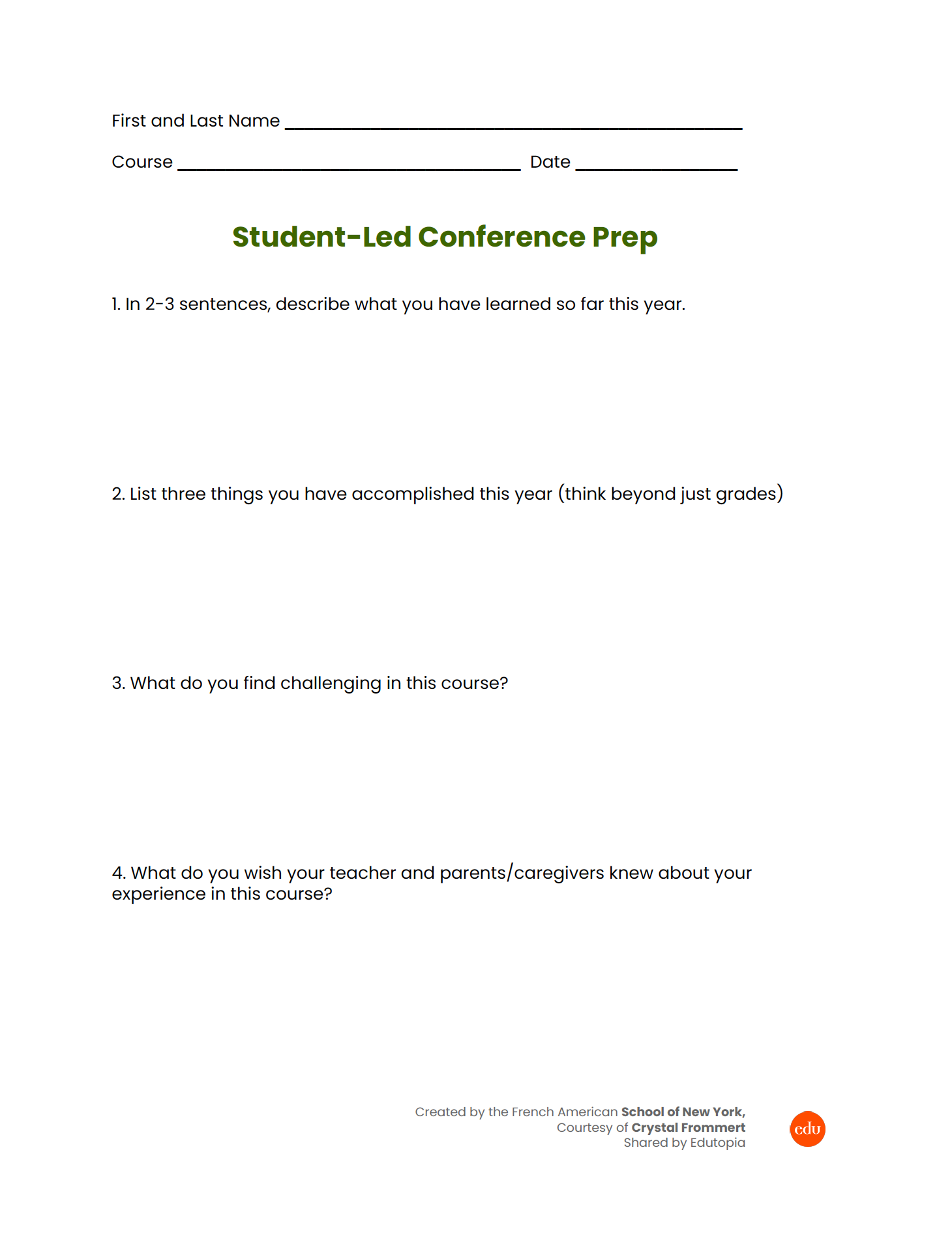
Take extra time to prep for students who are doing fine: Ten minutes isn’t a long time to discuss students who need to improve, but it may feel like too much time to discuss those students who are doing everything expected of them. Telling the parents, “She’s doing great!” doesn’t say anything specific about the student as a learner.
Think beyond the traditional success markers like grades and appropriate conduct. A student who is making an A may not need to study more, but perhaps they need to take more risks. If they are curious about a topic, are they exploring it? Do they have great ideas on paper but could speak up more in class discussions?
This shouldn’t feel like nitpicking, particularly if the student is doing really well. My point is that every student can continue to grow, and the conference is a chance for you to look closer at how they can really thrive and expand their learning, and share that with their family.
I avoid comparing a child with other students and making comments like “She has the highest average in the class.” I have found that comparisons are not helpful, and it’s best to focus on the student as an individual.
Be clear, honest, and kind: As professionals, we strive to be polite and courteous. However, this can go too far if a student needs to work to improve and we sugarcoat what we need to say—it’s our responsibility to tell students and parents where the student needs to improve.
I used phrasing like this with a student: “When you whisper to friends during the lesson, it’s distracting you and everyone around you. You’ll get so much more out of the class if you can reduce the side conversations.” Or I might say to a parent, “Jake has improved with multiplying fractions. He needs to put in the same effort to practice adding fractions.” Both comments are kind and honest and offer constructive, actionable feedback. Having a few work samples to show will ensure that the discussion focuses on evidence of the student’s work, making it clear that you’re not commenting on them as an individual or sharing an opinion.
Remember to use language that is clear for non-educators—most parents are not familiar with school jargon. I remember explaining ERB scores to a parent using terms like CTP 5, stanine, and norm-referenced. Now I make sure to adjust my terminology to meet parents’ understanding.
End each meeting with a forward thought directed to the parent or caregiver, such as, “What do you envision that your child should gain from this course?” Just as the meeting began with a student and parent question, wrap it up by letting the student and parent share their final thoughts. They will walk away from the conversation with a feeling of future-oriented hope.
Better online meetings: While I prefer to talk face-to-face, many schools are shifting to virtual conferences, which makes sense with our fast-paced society and parents’ busy work lives. Even though you’re missing some human connection when you meet online, there are ways to make the experience more engaging.
Before the meeting starts, check the basics. Is your laptop charged? Do you have headphones ready? Is your background or room noise distracting?
If you would usually show a sample of student work in an in-person meeting, take a photo of it to share with parents when you’re explaining something specific. If you display the work via sharing your screen, be very careful to only reveal tabs and windows that you want the family to see—make sure not to share your grade book or email tabs.
To foster a stronger sense of connection, position the video window at the top center of the screen so you can see parents’ faces while also looking into the camera. (I usually hide my own camera view—I know what I look like already.) Make the conversation as warm as possible by greeting each person and asking for their input.
Parent-teacher conferences can be exhausting, but they’re worth the effort. Teachers and parents are partners in supporting students’ growth, and conferences give us an opportunity to strengthen that partnership. My final tip is to continue to build that partnership—don’t let a 10-minute conference be the only time you connect with families. Reach out early in the year, keep communication going afterward, and follow up when needed. The benefits of that partnership extend well beyond 10 minutes.