
A Research-Based Strategy for Guiding Students to Engage in Productive Struggle
Persisting through challenges is a key skill for students, and teaching them about others who have succeeded after difficulties is an effective way to support them.
Your content has been saved!
Go to My Saved Content.We’ve all seen students experience confusion in the classroom, moments when math is an alien language or history feels like mapping shadows. Students’ backs tense into boulders, their pencils stop moving, and they mumble their frustrations. It’s a vulnerable space between giving up and pushing forward, and students may question their intelligence. Helping them rewrite their inner script from “I’m not smart” to “What does this challenge teach me?” is part of preparing them for productive struggle.
Productive struggle involves working through challenging ideas to develop understanding—as Stanford Professor Jo Boaler says, “If you aren’t struggling, you aren’t really learning.” In mathematics, Hiroko Warshauer describes teacher practices that support this process, including asking students to explain their thinking, offering time to explore, and helping them “approach the problem without solving it for them.” Those ideas apply beyond math, of course—the key is for teachers to stay involved, providing guidance and ensuring that learners have the prerequisite knowledge to get unstuck.
To encourage students to persist when challenged, one strategy is to share struggle-to-success narratives that detail how someone worked through setbacks, uncertainty, and mistakes. Research described below suggests that these exemplar stories can increase students’ persistence.
Research on Struggle-to-Success Exemplars as Models of Productive Struggle
Several studies have tested what happens when children hear about individuals who struggled. In a 2022 study of 4- and 5-year-olds, researchers shared stories about Albert Einstein or Marie Curie. Children then were given an impossible task. Those who heard about intellectual struggles persisted about 79 seconds on average, and those who heard about life struggles about 74, compared with 55 seconds for children who didn’t hear either story. Similar persistence effects were seen in a 2024 study with preschool students and their caregivers.
A 2026 study involved early elementary students who listened to commercial storybooks featuring “perseverant characters” each day for three days. Children who heard stories about overcoming adversity showed significant increases in time on task as well as number of attempts and accuracy on challenging tasks 24 hours later.
A 2016 study of high school students who read about scientists’ intellectual or personal struggles earned higher science grades afterward than those who read achievement-only stories; the grades of these latter students actually declined. Although the effect was small, results were “more pronounced for low-performing students.”
These studies show that sharing stories about people’s struggles can shape students’ persistence, effort, and grades.
What qualities in exemplar narratives are most effective for motivating students? According to a 2021 review of 55 STEM role-model studies, students found struggle narratives more motivating when they portrayed the role model in the following ways.
- Competent and successful: The narrative should describe the exemplar’s agency in their success; caution is needed in selecting these stories, however, because extreme success can be perceived as unattainable and thus fail to motivate students.
- Similar to the students: The role model’s journey should resonate with the specific struggles a particular group of students is facing.
- From traditionally underrepresented groups: Underrepresented role models have the “broadest positive effects” on students from all backgrounds.
In general, effective failure-to-success stories require a plausible bridge between students and the exemplar. When that bridge feels believable, students can perceive productive struggle as normal and manageable.
Selecting Stories That Support Productive Struggle
A few guidelines can help keep exemplar narratives credible and useful in showing what achieving success actually requires.
- Steer clear of the platitude “Anyone can do anything if they work hard.”
- Don’t forget to highlight the specific behaviors that students can imitate. For example, you could talk about a student who realized she couldn’t focus at her chaotic kitchen table. So she worked in the school library for the first 30 minutes of study hour to complete her most challenging homework first. This strategy gave her momentum to finish the rest at home. When telling stories like this, provide a clear connection between the setback and the reasoning and behaviors that helped resolve the issue.
- When sexism, prejudice, and poverty contribute to the protagonist’s struggle, be careful not to claim that an individual’s persistence alone can overcome systemic barriers.
- Don’t tell the stories solely of famous people—mix in lesser-known local professionals, older students, and teachers.
In a 2016 study, researchers noted that students had difficulty identifying the role model’s goals and strategies. So they directed students to create learning contracts describing two actions they would take in science class based on the stories. Examples: “Consult a teacher,” “Complete practice problems,” and “Ask questions in class.”
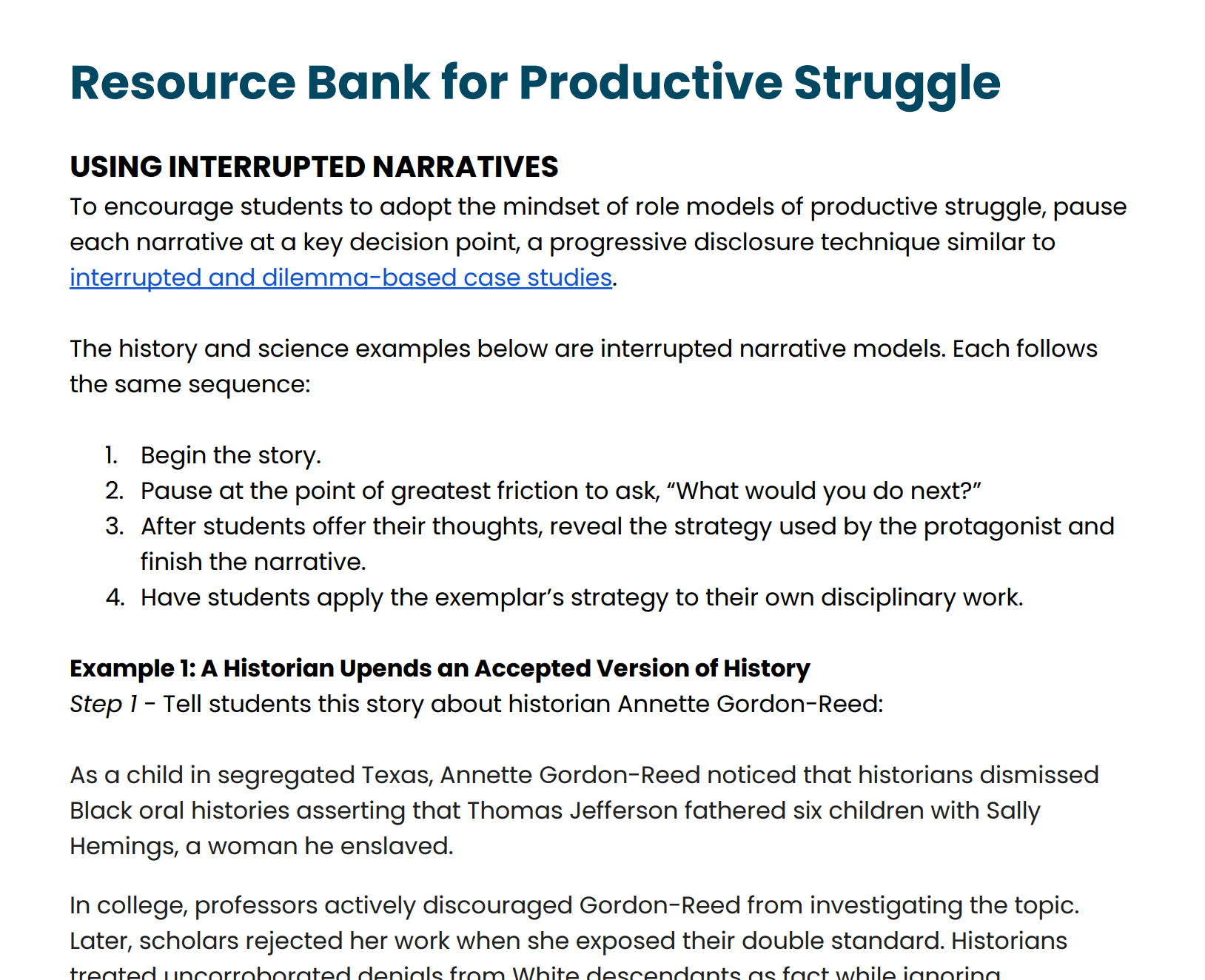
By designing lessons that require students to wrestle with the same issues faced by an exemplar, you can transform these narratives into occasions for active problem-solving. One powerful format for this is the interrupted narrative—a progressive-disclosure case study where the story pauses at a critical point, prompting students to weigh decisions and adopt the strategic mindset of a role model before discovering the outcome.
Find an example, along with implementation steps, in the resource bank below. The bank also includes short descriptions of several people who used effective strategies to work through setbacks, uncertainty, and failure.
Where to Find Struggle-to-Success Narratives
Several struggle-to-success narrative archives, organized by discipline, career, and type of setback, make it easy to find the right stories for your class.
- Roadtrip Nation: Young interviewers ask professionals about their routes to success in this video resource. The interviews feature accounts of firings, rejections, and forced pivots.
- The Moth Education Program: This storytelling program allows listeners to find episodes by theme; try searching for “resilience” or “failure.” Because some broadcasts contain mature themes and language, vet episodes before using them in class.
- TED: The Benefits of Failure: This curated playlist of lectures and animated shorts spotlights historical figures who overcame repeated failures.
- NPR’s How I Built This: In over 800 interviews, successful founders and innovators reveal their darkest moments before they turned their professional lives around.
- StoryCorps’ Narratives About Struggle: Everyday people discuss life-altering challenges, educational roadblocks, and career dead ends in first-person audio recordings.
You’ll find that these stories follow a consistent trajectory that students can recognize and use when they inevitably face an academic obstacle:
Struggle → Analysis → Strategy → Action → Result
While it’s natural for students to admire role models, the primary goal is for students to implement effective strategies themselves. To surface those methods, have the class respond to a few prompts after each story:
- What did the unsuccessful attempt reveal?
- What did the person change or learn?
- Which strategies from the story could help with the tasks we’re working on?
Research suggests that struggle-to-success narratives can strengthen motivation, persistence, and performance, with the greatest benefits occurring among lower-performing students, especially when they can identify with the role model’s struggle. Yet a borrowed narrative can’t substitute for students’ own experiences of success. To encourage productive struggle, pair these stories with opportunities and support to try the strategies depicted in the narratives. They will become most useful when students can identify what the role model actually did and, in the midst of their own difficulty, ask, “What do I try now?”