
How to Create a Crisis Handbook to Prepare Your School for Emergencies
As a school leader, you can’t anticipate when a disaster may happen, but you can develop systems to help ensure that your staff and families are prepared.
Your content has been saved!
Go to My Saved Content.Health crises, natural disasters, and sudden infrastructure failures are no longer rare events in schools. While schools can’t determine when or how disruptions happen, school leaders can choose how to deal with them. As school administrators at the International School Yangon (ISY) in Burma, we wanted to figure out how to prepare not only ourselves, but our staff, our students, and our students’ families for crises.
We know that preparedness is critical, and we wanted to codify our systems and routines in a way that helped everyone feel ready to act in case of an emergency. We decided to create a crisis handbook that would outline the structures, expectations, and routines that everyone should follow during a significant disruption.
DESIGNING A CRISIS HANDBOOK TO IMPROVE PREPAREDNESS
When we set out to create a crisis handbook, we knew we couldn’t plan for every single specific outcome—that would leave us with an overly lengthy document that no one would really turn to. Instead, we wanted to create something more accessible that school staff and families could learn from. We decided to focus on specific roles, decision-making plans, and communication flows that could be applied to a wide variety of scenarios.
1. Start with the purpose. Clearly define the handbook’s purpose and place it on the first page. State who the plan is for, what it aims to protect, and the school’s top priorities in a crisis.
In the ISY handbook, we state: The ISY Crisis & Security Plan has been developed for the safety of students, faculty, staff, and visitors. The purpose of this plan is to increase awareness of campus safety and security by identifying procedures to be followed in the event of a crisis situation. Should a crisis arise, the first priority will be the safety of all students, faculty, and staff. The second priority will be to inform parents of the status of their children and the emergency.
2. Clarify leadership and roles. Identify the chain of command with one key leader. For example, at ISY, this is the school director. List the crisis management team members, and clearly define their responsibilities. Include contact details and a simple chain of command. Beyond these leadership roles, it can be helpful to create a decision matrix that outlines what each different group within the school should be doing in the event of a crisis.
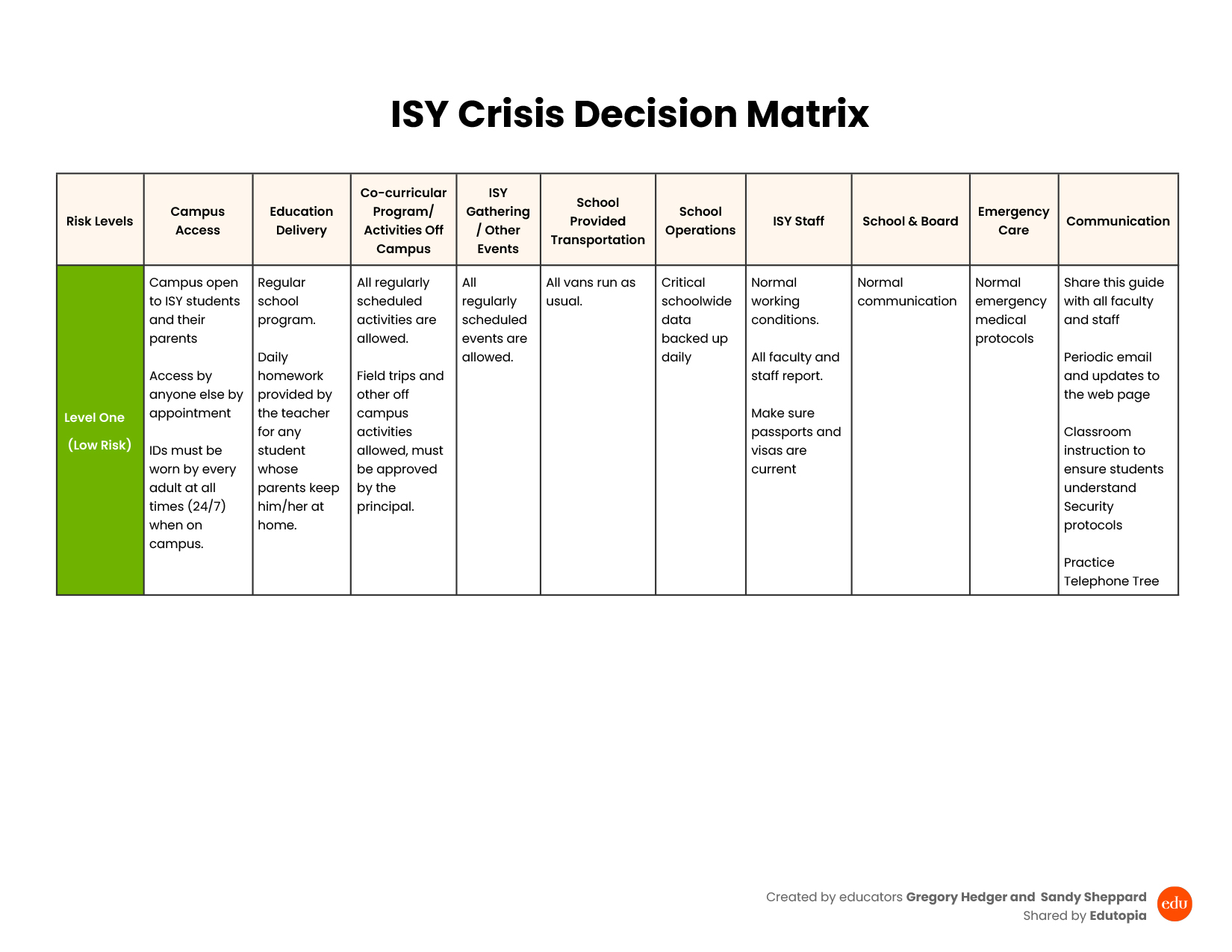
The ISY crisis handbook includes a decision matrix at the start of the handbook that identifies five different risk levels and the actions that should be taken at each. The crisis team can determine the risk level and then use the matrix to quickly and clearly outline next steps.
3. Organize by crisis category. Create a clear table of contents to ensure easy accessibility. Group procedures for likely scenarios such as fire, earthquake, lockdown, or shelter in place. For each scenario, outline the following:
- The procedure, including evacuation routes
- Key decisions/roles and responsibilities
- Communication steps
Use short bullet points and direct language so that staff can follow procedures under pressure.
4. Keep it practical and accessible. Avoid long explanations. Use clear headings, visual guides, and step-by-step lists. The handbook should support action, not require interpretation.
5. Practice and refine. Test procedures through schoolwide drills. This allows the entire crisis team, and the students, to walk through the steps outlined and identify what is and is not working. After each drill, adjust unclear steps and remove unnecessary detail. Make sure written procedures match what actually happens in practice.
6. Review and share. Publish the handbook internally and, where appropriate, on the school website. The leadership team should review it annually, regardless of whether or not it has been necessary. When a crisis does occur, the entire team should reflect and revise the handbook as needed.
A strong crisis handbook is concise, clearly organized, and regularly practiced. Its purpose is to support calm, coordinated action rather than reactive decision-making.
BUILDING TRUST THROUGH CLEAR AND HONEST COMMUNICATION
Handbooks and drills give structure, but communication changes how people feel about a crisis. Families and staff frequently assess leadership based not on the crisis itself, but on how information is disseminated. Even when things are under control, unclear or inconsistent messages can make things worse. Good crisis communication starts long before something goes wrong.
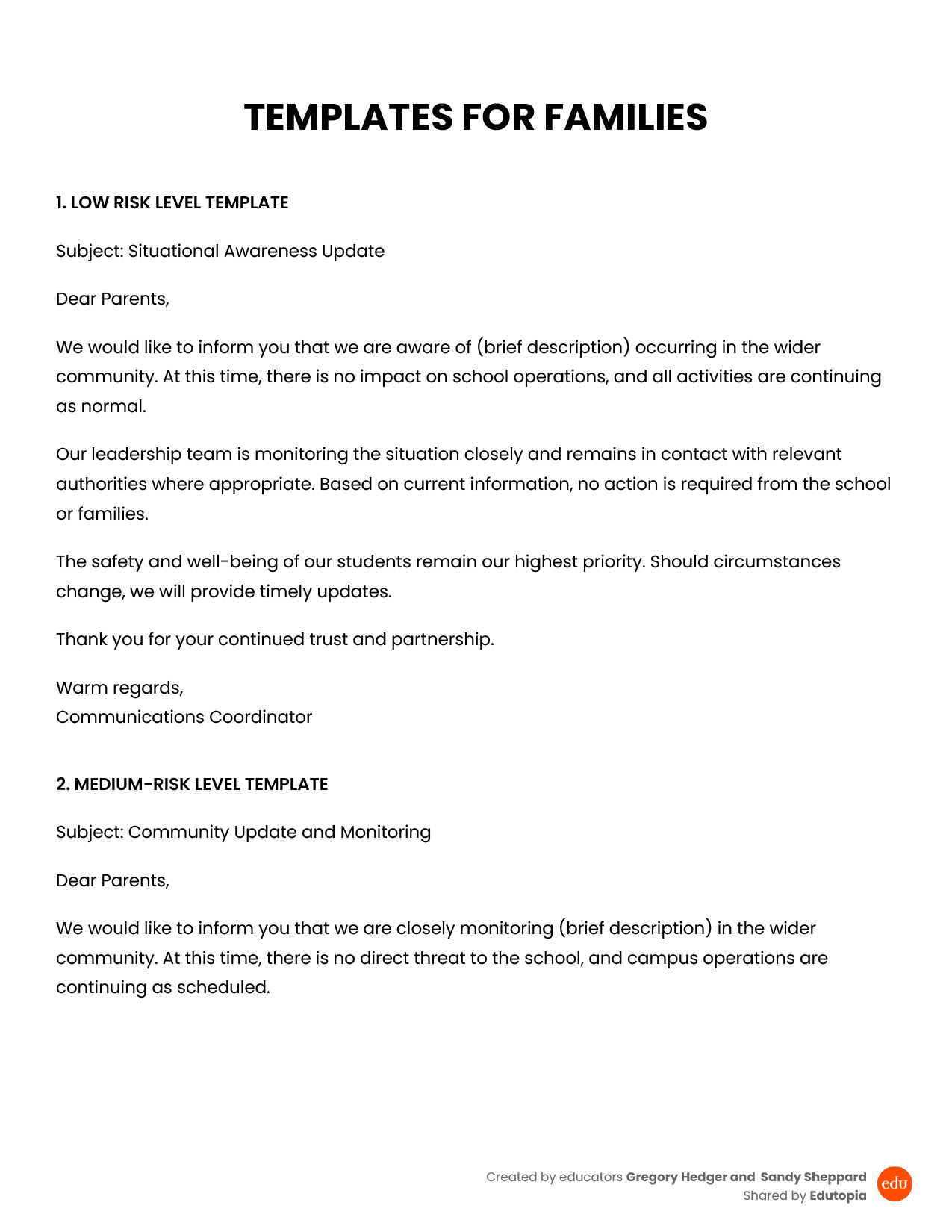
At ISY, our handbook outlines clear lines of communication that identify where information comes from, reducing confusion and rumors. The tone is just as important as the content. The handbook includes message templates so we can communicate clearly and calmly, even when we don’t have much time.
USING REFLECTION TO STRENGTHEN READINESS OVER TIME
Structured reflection helps schools address problems that arise during drills or real-life events. In class, students can talk about what felt clear, what confused them, and what helped them stay calm. During leadership debriefs, people can discuss how well they understood their roles, made decisions, and communicated with each other.
These reflections should inform any needed changes to the handbook. Reflections also help the community develop a sense of agency over time as they practice and reflect on what they have learned. Students will feel a sense of belonging rather than being told what to do. Instead of being reactive, employees will feel supported. Instead of feeling left out, families will feel included.
A clear crisis handbook builds preparedness. When this is in place, you are not just preparing for emergencies; you are demonstrating that the school community cares.