
How to Avoid Rushing—a Pitfall for Even the Most Experienced Teachers
There are always too many standards to meet and assignments to grade. These strategies can help you reject haste in favor of care and clarity.
Your content has been saved!
Go to My Saved Content.When I was a junior in high school, my English teacher returned one of my essays with a grade that was familiar to me at the time: a B. Normally, I would not have disagreed with her assessment, but I had worked harder than usual on this assignment because the topic interested me, and I was disappointed to see the result.
Confused, I asked her if we could discuss the grade when she had a free moment. The next day, she handed it back with an A on top. “I’m sorry,” she said. “I must have been in a hurry and didn’t give this a close enough look.”
In the years that followed, I have thought often about that experience. Even at 16, I knew my teacher hadn’t really read the essay the first time; she had graded based on expectation rather than evidence. It was a small mistake, but it changed how I viewed her and the trust I had in her feedback. When I became an English teacher, I resolved never to make the same error. Still, with piles of essays waiting and not enough hours in the day, I sometimes caught myself rushing. As teachers note in their comments on my recent article about why we make mistakes, hurried work easily leads to unintended consequences, even for the most experienced teachers.
Manage Pacing Before It Manages You
The longer we teach, the more we understand how to do it well; however, greater skill often leads to heavier workloads because as we gain more experience and internalize the complex nuances of skillful teaching, we often realize how much more students need in order to learn effectively. Never is this more evident than in curriculum pacing, which can feel like an albatross. As one teacher commented on my article above, “I feel like there is so much packed into the curriculum that we are expected to teach, and that causes me to panic, which causes me to rush through things. Then I’m left with ‘free time’ and struggling to find something to fill the gap.”
Curriculum changes are constant, so taking time to internalize what must be taught and prioritize what students need to know is essential. Suppose a science lesson identifies 15 pages of reading and 10 related questions for students to complete within a 45-minute block. Many students will struggle to meet this expectation, so teachers are faced with two choices: spread the lesson over more than one class, or determine what portions of the text and which questions are most important for achieving that day’s learning goal. I recommend the latter because it will not only prevent the dreaded problem of falling behind but also help teachers learn more about how the curriculum supports important standards.
For math classes, instructional specialist Celita Lewis-Davis describes how she coaches teachers through an upcoming unit: “Let’s look at this unit on factoring. At the end of unit assessment, what are the skills we know they must know in order to say, ‘I learned factoring in Algebra 1’? What does that look like?” Along these lines, teachers can highlight a couple of nonnegotiable standards in the pacing guide and underline one or two “nice to have” items that can be dropped if time slips.
Plan Instruction Around Both ‘What’ and ‘How’
With experience, teachers are better able to analyze materials and make thoughtful decisions about priorities. Unfortunately, that discernment also lengthens the workday—the more we know, the more time good planning requires, especially if we want to maintain some level of autonomy by balancing curriculum guidance with our own professional judgment.
Typically, a curriculum provides the “what” of teaching (content-based guidance and goals), while teachers have the flexibility to determine the “how” of delivery. In our earlier science lesson example, instead of rushing to cover every question, a teacher might assign one question per student partnership or have groups collaborate on particularly challenging questions. These choices promote deeper engagement and better pacing.
Strong instructional decisions also depend on collaboration, so it helps when teaching teams analyze data across many classes instead of relying on limited samples. Lewis-Davis advises that professional learning communities lean into the recursive nature of content to rid ourselves of the notion that we have to teach every skill to its ideal depth only once: “I believe in spirals. If you can’t get to something as thoroughly as you would like, or students show a need for growth, bring it back in some way to reinforce those skills.”
Grade Less, Do More
When my high school teacher graded my essay too quickly, she unintentionally damaged my trust. Even if students never have an experience like mine, they often believe that teachers are grading their work with bias or too slowly. With pressure from multiple quarters (administrators, students, parents) to provide feedback quickly, it can be difficult to stay on top of work without cutting any corners.
To avoid rushed grading, it helps to reflect on what feedback actually accomplishes. As Youki Terada and Stephen Merrill note, “The hours you commit to grading and commenting on every assignment and quiz are likely to be met with a shrug by your students.” Instead, they recommend focusing on a few high-impact areas for improvement. One of my favorite strategies for streamlining feedback is the holistic sort, which places formative data into two or three categories (such as “met,” “approaching,” or “not yet”). That way, we get a brief yet accurate picture of how students are doing.
For example, if students write a short constructed response (say, a paragraph) with the goal of identifying a main idea and some students have not done this correctly, the teacher is aware of who exactly is struggling. The next day, this teacher might allow students who met the standard to work independently for 20 minutes while pulling the “not yet” students aside for small group instruction on the skill. To try this out, pick one major assignment per week to receive detailed feedback and mark the rest with a quick holistic sort only. Research also indicates that students respond to feedback better when they see it without a grade—the latter is evaluative but is not considered feedback in and of itself.
Tame Deadlines
Teaching can feel like a losing game of whack-a-mole; as soon as one task is done, another seven pop up. So many responsibilities fall under the broad scope of what teachers are asked to do. For almost 20 years, I taught high school juniors, and when college recommendation season rolled around, I had to dig myself out of piles of letters (not metaphorically—there is actually a photo of me obscured behind all the envelopes) and make sure that every recommendation was sent to the right place. There was no margin for error, and the time pressure didn’t help.
When we’re feeling bogged down by the reality that it can be nearly impossible to get work done during the school day as students demand time and attention, it helps to think about tasks in terms of importance and urgency, per the Eisenhower Matrix. Categorizing tasks allows us to distinguish between what truly requires immediate attention and what can wait.
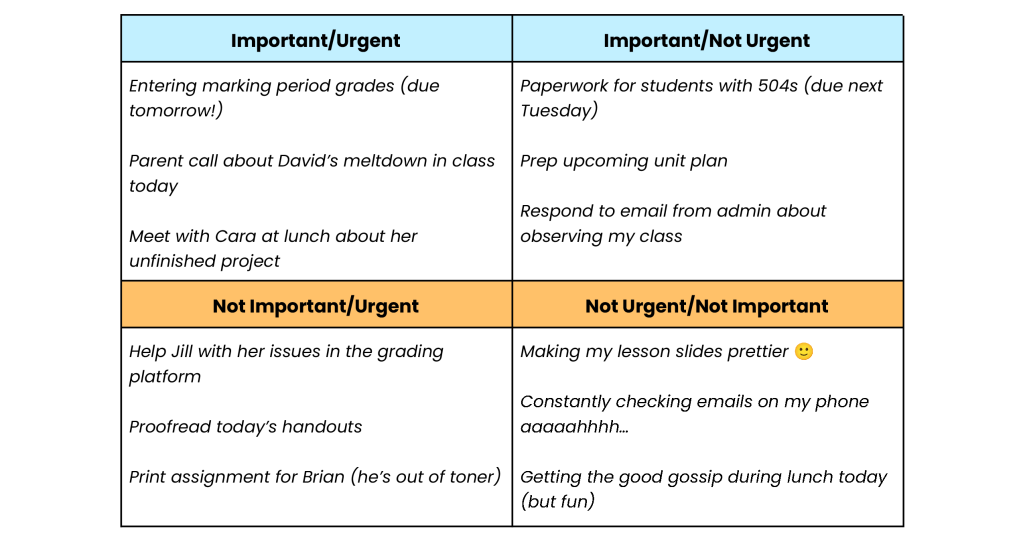
Sometimes, workloads can feel overwhelming because other people put pressure on us to get things done—but some of those tasks can wait if we make careful decisions about what is truly urgent. As one principal wisely told me, “Your urgency is not my urgency.” Her message was that perspective matters; what seems pressing may not hold equal weight for everyone. For example, most email correspondence fits into neither the important nor urgent categories, yet it can consume hours of a teacher’s limited time. To combat the urge to check email constantly, pause and protect one planning block per week as “no‑meeting, no‑email” time.
The best antidote to hurrying is intentional pause. Setting realistic goals, leaning on colleagues, and accepting that not everything can be done immediately all support more deliberate teaching. When we slow down, we plan with purpose, give feedback that matters, and build stronger relationships with students. Teaching will always involve long to-do lists and moving targets, but our most meaningful work happens when we reject haste in favor of care and clarity.