A Continuum of Play-Based Learning Approaches for Pre-K Students
Teachers can use this framework to implement various types of play depending on how each complements the day’s lessons.
Your content has been saved!
Go to My Saved Content.Young children learn best through playful approaches. But if you’ve incorporated play-based teaching and learning in your classroom, you’re probably aware that moving from research to application can be overwhelming.
I’ve experienced this struggle in the 4K (4-year-old kindergarten) classroom that I oversee alongside two educational assistants. Our public school and district administration support play-based learning, but it must be balanced with other important responsibilities, including Wisconsin’s statewide academic mandates and standardized assessments. Every 4K teacher in our district follows prescribed curricula in literacy, math, and social and emotional learning—and our school community follows a master schedule that allocates time for teacher-specialists, too.
Even still, play-based learning is the heartbeat of our classroom. It shows up throughout the day, an approach that allows everyone to meet expectations while protecting the joyful, developmentally appropriate learning experiences that young children need and deserve.
A BALANCED APPROACH TO PLAY-BASED LEARNING
The “Continuum of Play-Based Learning,” authored by researchers Angela Pyle and Erica Danniels, is a must-read. Through the use of the continuum, educators are able to clearly discern varied types of play based on the level of a child’s agency.
Free play and inquiry play are typically child-directed, while playful learning and learning through games are on the opposite end of the spectrum—they ask more of the teacher. Collaborative play sits in the middle of the continuum; children and adults have equal roles in the play experiences. Below is more information on each playful approach.
WHAT PLAY-BASED LEARNING LOOKS LIKE IN PRACTICE
Free play: At the furthest end of the continuum is free play, the most child-centered form of play-based learning. When children are engaged in this type of play, they choose what to play, how to play, who to play with, and what materials to use. Teachers provide the space, time, and materials without directing the play experience.
The go-to example of free play is recess. At my school, we take our 4K students outdoors, which includes a playground, a grass field, a blacktop with basketball hoops, and a gaga ball pit, as well as games painted on the ground, like hopscotch and four-square. Based on our schoolwide master schedule, 4K students are given 30 minutes of recess. We’re able to extend that time by about 10 minutes when students don’t have to dress in winter gear.
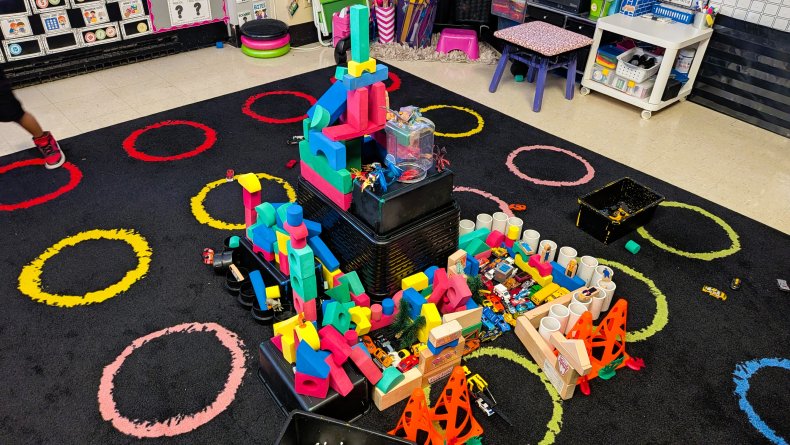
Inquiry play: According to the “Continuum of Play-Based Learning,” inquiry play is when a teacher follows students’ interests and extends their exploration with questions, materials, and new challenges. Children remain in control of their play.
Inquiry play is especially effective in the mornings as the soft start to each school day. As students enter the classroom, they have the freedom to explore any of the play invitations that we set up in advance. These invitations sometimes have a specific goal in mind. For example, children love talking about animals, a topic of interest that often surfaces in our classroom. To cultivate more animal knowledge, we create play invitations that include magnifying glasses, nonfiction animal books, a bird’s nest, a bison tailbone, a snake skin, feathers, and other realia that have been donated to our classroom. Through this type of inquiry play, students practice vital science skills and standards.
Other times, inquiry play is the result of students’ newfound interests. For example, my students were immediately intrigued by planes and flight after reading a big book from our district-mandated curriculum called Riding an Airplane. The next morning, we prepared a quick play invitation about paper airplanes. We looped a “how to make a paper airplane” video on our board and left out paper and the read-aloud book nearby. This invitation extended our book conversation from the day prior, and it provided students with an opportunity to follow step-by-step directions while building their fine motor muscles.
Collaborative play: During our daily play workshop, students sometimes engage in collaborative play—a daily block of time that consists of three parts.
- Focus lesson: Engage in whole-group learning that highlights a skill or idea that students can choose to apply during their play.
- Play and exploration: This time makes up the bulk of the play workshop. It’s when students engage in self-selected, child-led play.
- Group share: Teachers and students gather on the carpet and share about our play experiences.
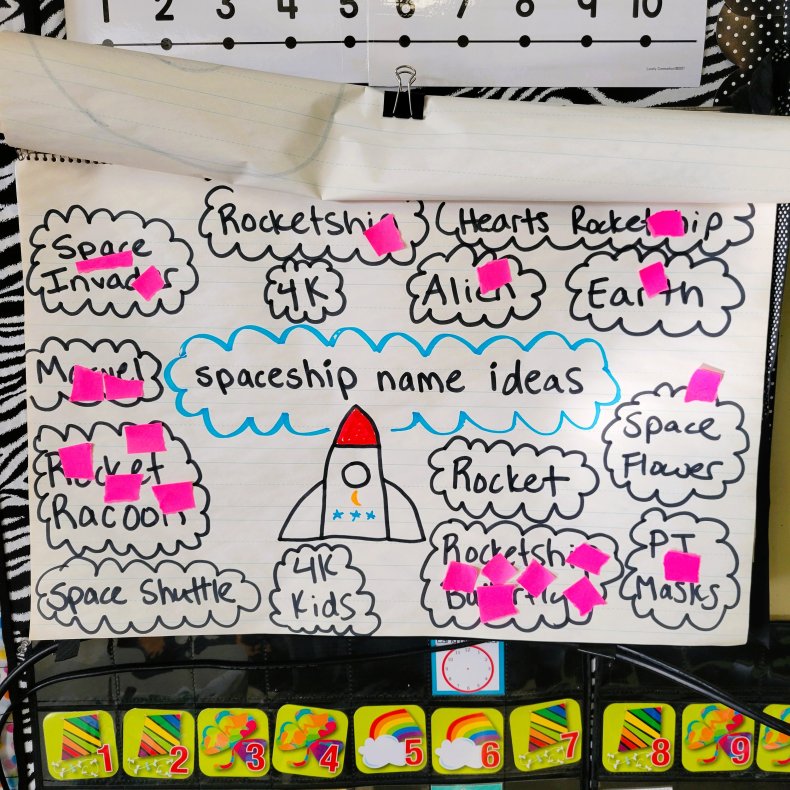
One example of the collaborative play process is choosing and setting up our imagination center (a dramatic play area, basically). Across several sessions, we invite students to brainstorm and share ideas about what they want the imagination center to become. Then we all vote to determine a winning idea—something like a space station. Next, we ask students to share their thoughts about what the space station needs: A rocket ship? Astronaut suits? A computer? From there, we gather materials and set up the imagination center. Whenever possible, we cocreate materials with the students; they might participate in painting a cardboard rocket ship or giving it a name. Once the foundation is laid, we open the play center and continue to make adjustments over the course of several weeks, based on students’ feedback.
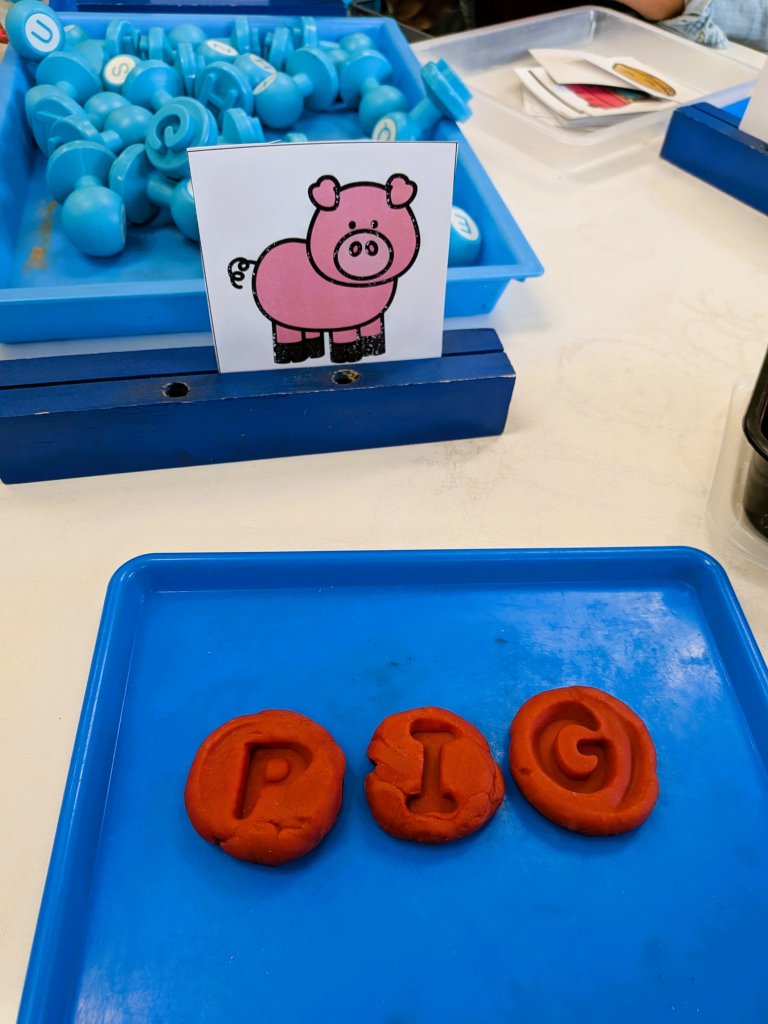
Playful learning: Literacy exploration, a 15-minute block of time within our district-required 60-minute literacy instruction, is an example of playful learning. During literacy exploration, students free-flow between teacher-designed stations that are set up around the classroom.
Our goal is to provide students with hands-on, playful invitations. If we’re encouraging a focus on the formation of uppercase letters, we might offer alphabet cards with Play-Doh, alphabet stamps, and ink pads, plus wooden “lines and curves” pieces and alphabet mats with small loose parts.
These high-interest, literacy-based invitations—playful materials paired with the freedom for students to come and go as they please—are a great example of how to accomplish district mandates through play-based learning.
Learning through games: In addition to frequent blocks of time for early-in-the-day inquiry play, our classroom community gathers on the carpet for a morning meeting. It consists of four parts: greeting, share, message, and group activity. The first three parts are fairly standard. For example, we might sing a name song (the greeting), pass a talking stick around the circle and discuss our weekends (the share), and communicate about upcoming classroom events (the message).
The group activity section is usually a game with a learning outcome in mind. The goal of the game is predetermined by the teachers, and there are specific rules that everyone follows in order to participate. There are endless gaming options! For example, we prompt our students to identify what’s on a card, and then pull that card out of a pocket chart to see if a picture is hiding behind it. We also play lots of classic games, like Doggy, Doggy, Where’s Your Bone? and Simon Says, with props like scarves and ribbon wands. Each of these group-based games is an opportunity for our students to learn targeted academic skills.
A MESSAGE TO KEEP IN MIND
Each play type is valuable for its own reasons. Each is worth implementing. Rather than putting pressure on ourselves to “correctly” select a play-based learning technique, early childhood educators should ask another question: Which play type best fits this particular part of our school day? Examining your entire schedule through this lens makes play-based learning far more manageable and realistic, all while meeting school expectations.