
12 Ways to Use Cues to Boost Students’ Effort in the Classroom
Teachers can use these research-based cognitive and behavioral cues to help students feel capable, focused, and ready to work, even when tasks are challenging.
Your content has been saved!
Go to My Saved Content.Teachers influence learning even before a lesson begins, not through speeches or slides, but through small, often invisible signals that students pick up about what matters, what’s safe, and what’s possible.
Psychologists call these behavioral and cognitive cues: subtle prompts that shape attention, motivation, belonging, and effort. Research shows that the cues teachers use can either lower cognitive load and increase engagement or quietly shut students down.
Once you know what to look for, cues become some of the most powerful tools in a classroom. Because many of these signals operate below conscious awareness, they influence learning even when you’re not actively instructing. Below are 12 research-informed cues that help students feel capable, focused, and willing to try.
Cues That Signal Safety and Belonging
1. Name Use Cue: Using a student’s name early and often signals recognition and belonging. Research shows that even brief use of a name increases participation and trust.
How to use it: Say each student’s name during the first five minutes of class—taking attendance, doing a warm-up check, or during direct instruction.
Keep a seating chart clipboard, and intentionally rotate whose name you say out loud. In my class, I put a sheet protector over the roster. Using an erasable marker to keep track, I make sure to say each student’s name in a positive context at least once during class.
2. Mistakes-as-Data Cue: When teachers respond to errors with curiosity (“Let’s examine this”), students interpret mistakes as part of learning rather than as signs of failure. Studies show that reframing errors reduces threat response and supports learning persistence.
How to use it: When a student answers incorrectly, pause and say, “Let’s bookmark this.” Keep a visible, consistent spot for these bookmarks. Put sticky notes on the board or bookmark icons on your slides, or keep small magnets near your whiteboard.
Each day, intentionally pause on one or two mistakes and create a quick bookmark moment. The goal isn’t to correct every mistake. It is to briefly highlight an example that shows where thinking is developing. Name what the student was attempting and ask a question like:
- “What does this tell us we need to adjust or try next?”
- “Which part almost works?”
- “What was your brain trying to do here?”
Invite another student to revise or build on the idea. Over time, students learn that mistakes don’t stop learning; they signal where learning happens next.
3. Visible Norms Cue: When norms are cocreated with students and made visible, classrooms feel safer and more participatory because expectations are shared rather than imposed. Research on psychological safety shows that environments with clear, collectively owned norms increase student risk-taking, help-seeking, and engagement, especially during challenging learning tasks.
How to use it: At the start of a unit or term, ask one focused question: “What do we need from each other to feel safe enough to ask questions, try, and make mistakes?” Record student responses—in their language—and guide the class to agree on three to five short norms (e.g., “Confusion is expected,” “We revise thinking here”).
Post the norms at eye level. When behavior drifts, point to the norm or ask, “Which norm applies here?” instead of correcting verbally.
4. Warm Entry Cue: A predictable, calm welcome at the start of class signals safety and helps regulate students’ nervous systems before learning begins. Research on neuroception shows that students subconsciously assess safety within seconds of entering a space, and consistent warmth reduces stress responses and increases readiness to focus.
How to use it: Stand at the door or just inside the room and greet students with the same short, steady phrase each day, like “Good to see you” or “Welcome in.” Keep your tone calm and unhurried. As students enter, direct them to a clearly posted entry task that begins immediately, without discussion.
Treat the first minute of class like a runway for learning: predictable, calm, and ready for students to take off. Use the same greeting and the same entry task structure every day. Change the content of the task, not the routine. Over time, students learn that this space is safe, organized, and ready for learning.
Cues That Direct Attention and Focus
5. First Move Cue: Asking students to name the first step before beginning reduces task paralysis by easing executive load. Research on task initiation shows that deciding where to start often creates more friction than the work itself. When students externalize the first move, starting feels manageable, and momentum builds naturally.
How to use it: Before independent work, say, “Write the very first thing you are going to do. One sentence or phrase.”
Add a visible line on slides or handouts labeled “First Move.” Keep the routine the same so that students can begin without hesitation.
6. Point-and-Pause Cue: When teachers point to key information and pause, they direct attention without adding more verbal instructions. When students mirror the gesture, attention becomes embodied rather than passive. Research on attention and multimedia learning shows that spatial cues, combined with brief silence, help learners orient their focus and process information efficiently, while shared gestures strengthen attention and comprehension. Even with older students, this works well because it reduces the amount of talking that students have to process and makes the focus of the task immediately clear.
How to use it: Point to the exact word, sentence, number, or image you want students to notice. Pause briefly. Then ask students to point to the same place. When everyone locates the same spot, attention aligns quickly, sharpening cognitive focus.
Use point-and-pause to highlight key information that students need to understand in the lesson, rather than repeating directions or rereading text aloud. Over time, students learn that when you point and stop talking, it signals where their attention should go. The room settles, distractions fade, and students can focus on the key insight they need to grasp the information.
7. Look-For Cue: When tasks are large or complex, students often feel stressed before they begin, not because the work is too difficult, but because the brain has to decide where to focus while processing everything at once. This uncertainty increases cognitive load and can stall engagement. Research on selective attention shows that when learners are given a clear focus target, the brain filters irrelevant information more efficiently, reducing stress and freeing working memory for understanding and persistence. Naming what to look for helps students enter challenging work with clarity instead of hesitation, making effort possible because focus comes first.
How to use it: Before reading, viewing, experimenting, or solving, name one clear thing students should attend to:
- “Look for what changes.”
- “Look for the variable we are testing.”
- “Look for patterns.”
- “Look for where mistakes might happen.”
- “Look for the evidence that supports the claim.”
Say it once. Do not explain it further.
Use a Look-For before any substantial task, regardless of subject. Keep the structure the same, and change only the focus. Over time, students learn that focus is not about trying harder, but about knowing what to focus on first.
8. Task Framing Cue (the Why First): When students hear why a task matters before what to do, their brains register relevance before effort is required. Research on motivation and attention shows that perceived value increases intrinsic engagement, focus, and persistence, especially during challenging work. Meaning acts as an attentional filter. When the purpose is clear, students are more willing to invest effort.
How to use it: Begin directions with one short framing sentence:
- “This matters because it helps you make better decisions.”
- “This matters because it explains how things fail or improve.”
- “This matters because it helps you spot patterns faster.”
Then move directly into the task. Limit the frame to 10 seconds or less. One sentence. No backstory. The goal is orientation for what is being learned, not persuasion.
If the relevance of a task is not immediately obvious, I often use AI as a planning partner to generate concise, transferable reasons why students might care about the skill. For example, I might prompt an AI tool with: “Why would this skill matter in real life, future careers, or everyday problem-solving?” This helps me offer a clear, universal “why” without overexplaining or improvising in the moment.
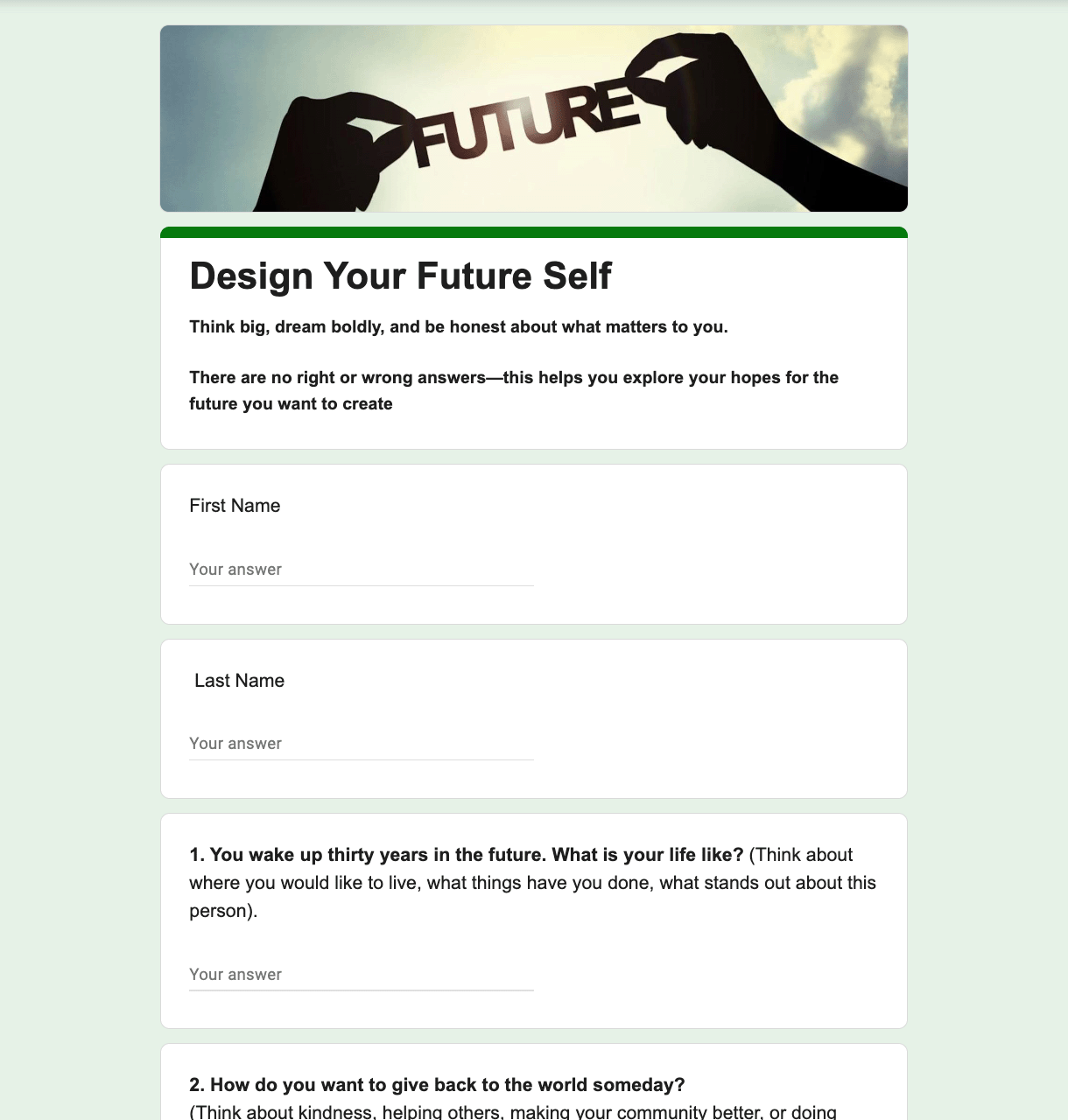
I also collect information about students’ future goals using a short Google Form, where they describe their aspirations and dreams. (Note about the Google Form above: After you click “Make a copy” on the first screen, if you see a pop-up that says “Missing File Upload folders,” please click “Restore.”) I use those responses to identify goals that matter to the class and connect class skills to the careers and dreams they care about.
Cues That Build Agency and Motivation
9. Effort Forecast Cue (Name the Hill): “Name the hill” means telling students where the work is likely to feel hard before they reach it. When teachers do this, struggle is framed as part of the task rather than as a sign of inability. Research shows that forecasting effort in advance reduces threat response and prevents negative self-attributions, helping students—especially those with anxiety or low academic confidence—to persist through a challenge with greater confidence and focus.
How to use it: Before students begin, name the hill in one calm sentence:
- “This part usually feels confusing before it makes sense.”
- “Most people need a few tries before this clicks.”
- “If this feels slow at first, that’s normal.”
Then step out of the way and let them work. Use one effort forecast per lesson, especially before tasks that require problem-solving, revision, or persistence. Keep it brief: No pep talk, just a heads-up.
10. Choice-with-Boundaries Cue (The Two Doors): Autonomy fuels motivation, but too many options drains it. Research on motivation shows that people are more engaged when they feel a sense of choice, as long as the choices are clear and limited. Offering two purposeful options gives students control without cognitive overload, keeping attention on the learning goal rather than the decision.
How to use it: Present exactly two options that lead to the same outcome:
- “Write your response or record it.”
- “Solve this independently or with a partner.”
- “Start with problem A or problem B.”
Use the same language each time: “Choose one of these two. Both meet the goal.” Over time, students stop asking which one is better and start owning their decision.
11. Language of Agency Cue (Name the Action): When directions sound purely like commands, students are more likely to disengage or comply without thinking. Small shifts in language can frame tasks as actions that students take rather than orders they must follow. Motivation research shows that people follow through more consistently when tasks are framed as clear actions rather than orders. The work stays the same; the language shifts.
How to use it: Rewrite the directions to highlight the thinking actions that students should take rather than simply stating the task. Swap simple command verbs for language that highlights the thinking action that students should take.
A few examples:
- “Do the worksheet” can be replaced with “Work through the problems step-by-step” to emphasize problem-solving and reasoning.
- “Answer the questions” can be replaced with “Explain or record your responses” to emphasize that students should articulate their thinking.
- “Read the passage” can be replaced with “Examine the passage and note key ideas” to emphasize analysis and observation.
- “Solve the equation” can be replaced with “Work through the equation to determine the unknown value” to emphasize mathematical reasoning.
- “Do the lab” can be replaced with “Conduct the experiment and observe what happens” to emphasize scientific investigation.
These small shifts frame the task as a thinking action that students take, reinforcing agency while keeping expectations clear.
As you plan or post directions, revise one line to remove command language. Over time, this becomes a habit that quietly reinforces agency across subjects without changing expectations or adding time.
12. Effort Attribution Cue (Name the Strategy): When feedback focuses on how students succeeded rather than who they are, they are more likely to repeat effective behaviors. Research shows that naming strategies instead of ability strengthens persistence and adaptive effort.
How to use it: When giving feedback, avoid ability-based praise and reframe it around the strategy you observed.
- Instead of “You’re so smart,” say, “That worked because you checked your steps.”
- Instead of “You’re good at this,” say, “Your argument got clearer when you organized your ideas first.”
- Instead of “You tried really hard,” say, “Your effort showed when you revised using the feedback.”
During independent practice, listen for moments when students are applying a strategy or adjusting their approach. Use one brief strategy-based comment while students are working to reinforce what helped them move forward and boost motivation in the moment.
Why Cues Matter More Than We Think
Every classroom sends signals. The only question is whether they’re intentional. Students are constantly scanning for answers to unspoken questions: Is this safe? Does this matter? Can I do this?
Cues answer those questions before instruction ever begins. They shape how students approach a task, how long they persist when it gets hard, and whether they believe the effort is worth it. When those signals align with how the brain learns, students lean in. They try longer. They risk more.
The most powerful cues aren’t complicated or time-consuming. They live in ordinary classroom moments. When teachers shape them with intention, they change what is possible—because belief is built from cues long before achievement shows up.